Showing posts with label #TechCrunch. Show all posts

Wednesday, September 15, 2021

Sustainable e-commerce startup Olive now ships beauty products, in addition to apparel

Earlier this year, a startup called Olive launched its new shopping site and app with the goal of making e-commerce more efficient, convenient, and sustainable by offering a way for consumers to aggregate their orders from across retailers into single shipments that arrive in reusable packaging, not cardboard. If items need to be returned, those same packages are reused. Otherwise, Olive will return to pick them up. Since its February 2021 debut, the company has grown to include over 100 retailers, predominately in the fashion space. Today, it’s expanding again by adding support for another 25 beauty retailers.

Launch partners on the new effort include brands like Supergoop!, Kora Organics, Pai Skincare, Erno Laszlo, Jecca Blac, Sahajan, Clark’s Botanicals, NuFace, Purlisse, Cover FX, LYS Beauty, SiO Beauty, Peace Out Skincare, Koh Gen Do, Julep Beauty, In Common Beauty, Indie Lee, Glow Recipe, Ursa Major, RMS Beauty, Ceremonia, Sweet Chef, Follain, and BalmLabs.

They join Olive’s numerous apparel and accessory retailers like Adidas, Superga, Rag & Bone, Birdies, Vince, Goop, Khaite, and Veronica Beard, among others.

To support the expansion, Olive also developed a new set of reusable packaging that has protective elements for more damageable items. While before, the company had offered a variety of packages like soft-sided garment bags and various sizes of more rigid containers (see below), it’s now introducing its own alternative to the air bubble strips you’ll find in most Amazon boxes these days. Olive’s version is integrated into its reusable packaging and can be easily deflated by the customer when it’s time to return the package at pickup.
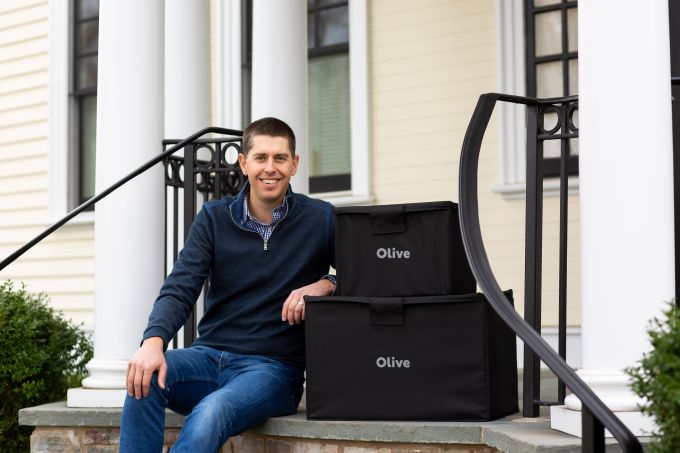
Image Credits: Olive, founder Nate Faust

The idea for Olive is a timely one. Due to the Covid-19 pandemic, e-commerce adoption has soared. But so has consumers’ guilt. Multiple packages land on doorsteps every week, with cardboard and plastic to recycle — if that’s even available in your area. Delivery trucks — Amazon, UPS, FedEx, and others — are now a daily spectacle on every city street. Meanwhile, market leaders like Amazon and Walmart seem largely interested in increasing the speed of delivery, not necessarily the efficiency and sustainability. (Amazon allows shoppers to pick an Amazon Day delivery, for consolidated shipments, but it’s opt-in.)

Olive founder Nate Faust says he was inspired to build the company after realizing how little interest there was from larger e-commerce players in addressing some of the inconveniences and inefficiencies in the market. Faust had previously served as a vice president at Quidsi (which ran Diapers.com and Soap.com and sold to Amazon), then co-founder and COO at Jet, which was acquired by Walmart for $3.3 billion. Before Olive, he was a senior vice president at Walmart.

After some soul searching, he realized he wanted to build something in the e-commerce space that was focused more on the social and environmental impact, not just on driving growth and consumption.
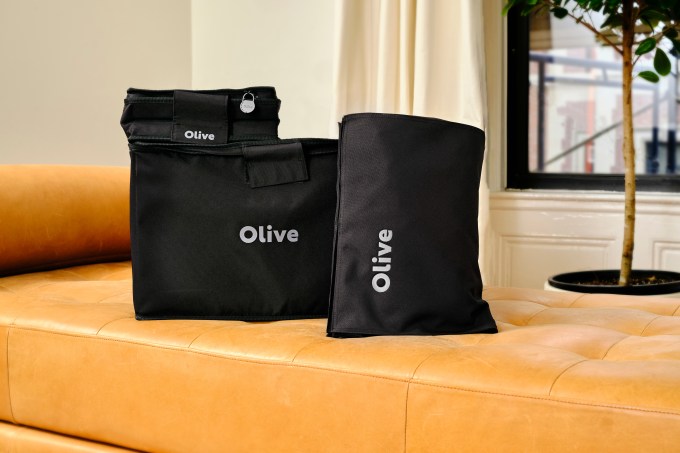
Image Credits: Olive

“I had an epiphany one evening when taking out the trash and recycling,” Faust explains. “It’s pretty crazy that we’re this far into e-commerce and this is the status quo delivery experience —  all this waste, which is both an environmental issue and a hassle for consumers,” he says. “And the bigger issue than the packaging is actually the fact that the majority of those packages are delivered one at a time, and those last-mile emissions are actually the biggest contributor of carbon emissions in the post-purchase e-commerce supply chain.”

Consumers may not think about all the issues, because many of them are hidden, but they do struggle in other ways beyond dealing with the waste. Returns are still a hassle — so much so, that Amazon now allows customers to go to Kohl’s where it’s partnered on in-store return kiosks that also help the brick-and-mortar retailer increase their own foot traffic.

Plus, consumers who shop from different sites have to set up online accounts over and over, entering in addresses and payment information many times, which is an annoyance. Olive offers the convenience of an Amazon-like one-stop-shop experience on that front.

Meanwhile, Olive addresses the return issue by allowing consumers to simply place their unwanted items back in Olive’s packaging then leave them on their doorstep or with the building’s doorman for return. It works with both the USPS and a network of local carriers to serve the customers in its current footprint, which is about 100 million U.S. consumers on both coasts.

While customers don’t have to deal with packaging, it hasn’t been entirely eliminated from the equation at this point. Olive today partners with retailers who ship packages to its own west coast and east coast warehouses, where they repackage them into the reusable containers to deliver to customers. Right now, that means Olive is responsible for the recycling issues. But it’s working with its brand partners to have them pack orders directly into the reusable packaging from the start — before shipping to Olive’s consolidation warehouses for delivery. Today, it has a few retailers on board with this effort, but it hopes that will eventually expand to include all partners.

The company generates revenue on an affiliate commission model, which works for now. But over time, it may need to evolve that business model over time, as its customer base and partnerships grow. At present, around 10,000 consumers have used Olive, ahead of any large-scale marketing and customer acquisition efforts on the startup’s part.

For now, New York-based Olive is growing its business by way of a fundraise of around $15 million from investors including Invus, Primary Venture Partners, and SignalFire.

Techcrunch?d=2mJPEYqXBVI Techcrunch?d=7Q72WNTAKBA Techcrunch?d=yIl2AUoC8zA Techcrunch?i=1Hrby7w222M:F__5iYpkJWQ:-BT Techcrunch?i=1Hrby7w222M:F__5iYpkJWQ:D7D Techcrunch?d=qj6IDK7rITs

Source: https://techcrunch.com/2021/09/15/sustainable-e-commerce-startup-olive-now-ships-beauty-products-in-addition-to-apparel/
Droolin’ Dog sniffed out this story and shared it with you.
The Article Was Written/Published By: Sarah Perez


! #Headlines, #BusinessNews, #Newsfeed, #Sustainability, #TechCrunch, #TechNews, new york nyc NY nypd nyfd, #Coronavirus, #Health, #News, #Science, #ThePlanet

Tuesday, June 22, 2021

Twitch suspends two popular female creators over sexy ASMR streams

GettyImages-1228979901.jpg?w=600

Popular Twitch streamers Amouranth and Indiefoxx are the two latest casualties of Twitch’s ongoing battle to enforce its own confusing rules around sexually suggestive content.

Both creators were suspended following ASMR streams that pushed the bounds of Twitch’s community guidelines forbidding content that isn’t quite sexual in nature but is still too risqué for a platform deeply self-conscious about its advertising business. The Amazon-owned company declined to comment on the length of the bans or what provoked them, but pointed TechCrunch toward its rules on sexual content.

It’s possible that both Amouranth (Kaitlyn Siragusa) and Indiefoxx (Jenelle Dagres) will be reinstated Monday, 72 hours after their Friday ban, but both channels remained unavailable at the time of writing. Siragusa confirmed to Polygon that she was suspended after a stream in which she did yoga poses while making ear-licking sounds into a microphone.

The so-called “ASMR-meta” on Twitch, where streamers boost their views by whispering into their microphones or producing licking sounds, sometimes while holding yoga poses, follows the controversy around hot tubs on Twitch that exploded last month. In both instances, some Twitch creators believe that the platform’s rules are selectively enforced.

“With ASMR meta and crazy yoga poses, believe it or not I watched two other girls doing it to the tune of 2-5k views without any bans for months before I folded the activity into ASMR creating the infamous ‘ASMR’ meta,” Siragusa wrote on Twitter. “Those other streamers are still unbanned and continue to do it. My sin was taking inaction as a sign of tacit acceptance, and then blowing the top off the secret and hitting 30k viewers.”

Because both the ASMR meta and the hot tub meta were dominated by female streamers, the whole situation has attracted even more misogyny within the Twitch community, where female streamers are still regularly harassed off the platform.

I will always find it ENORMOUSLY IRONIC that the generation that fought “violent video games don’t cause an uptick in gun/violent crimes”(I agree), instantly turn tail & succumb to a bad take like “HOT TUB/ASMR GIRLS LITERALLY CREATE CREEPERS that plague other girl creators!”

— Kaitlyn (@wildkait) June 20, 2021

In a blog addressing the proliferation of women streaming from pools and hot tubs at the time, Twitch wrote that “being found to be sexy by others is not against our rules, and Twitch will not take enforcement action against women, or anyone on our service, for their perceived attractiveness.” The company clarified that while a bathing suit in a bedroom might break the rules, “contextually appropriate” swimwear is allowed.

Twitch also acknowledged the complexity of its own difficult to parse rules:

Our intention with the Sexually Suggestive policy was to draw a line on content that is overtly or explicitly sexually suggestive, not to ban all content that could be viewed as sexually suggestive – but we acknowledge that our rules are not as clear as they could be.

Prohibiting every form of content that could be interpreted as suggestive would also result in far more restrictions on the video games and premium content that we currently allow, especially considering the ways that female characters are sometimes objectified or presented in a sexualized manner.

Its solution at the time was to create a “Pools, Hot Tubs, and Beaches” category where that content could live. Most of Twitch’s categories are dedicated to specific games, with most of the platform’s nongaming streams listed in the popular catch-all category “Just Chatting.”

ASMR has its own category, with 2.4 million followers, encompassing ear-tingling ASMR streams that don’t push the boundaries of Twitch’s rules with the more recent crop of those that do. So far, instead of building out a more thoughtful way to corral sexually suggestive content, the company is opting to punish anybody who it decides crosses the line. But it’s possible that could all change: Last month, Twitch said it was working on new policies to further clarify the rules on sexually suggestive content.

Unfortunately for Twitch — and for the female creators disproportionately affected by its uneven policies — the abundance of ear-licking streams suggests that until then, the company will be making these same determinations over and over as it tries to draw a line within a gray area of its own making.

Adblock test (Why?)

Source: https://techcrunch.com/2021/06/21/twitch-asmr-meta-amouranth-indiefoxx/?utm_source=feedburner&utm_medium=feed&utm_campaign=Feed%3A+Techcrunch+%28TechCrunch%29
Droolin’ Dog sniffed out this story and shared it with you.
The Article Was Written/Published By: Taylor Hatmaker


! #Headlines, #Censorship, #Newsfeed, #Streaming, #TechCrunch, #TechNews, #TechnologyNews, #Twitch, #Video, #News, #Politics

Tuesday, June 8, 2021

Ford unveils Maverick, a compact hybrid pickup truck for under $20,000

Ford unveiled on Tuesday the Maverick, a new compact hybrid pickup truck for people who didn’t know they needed one.

The truck’s smaller more approachable size and its base price of $19,995 is geared towards entry-level customers who want that SUV or truck lifestyle as well as the ease of navigating and parking in tight urban centers. And while its not an all-electric truck like the upcoming Ford F-150 Lightning, the Maverick is part of the company’s recently expanded plan to invest $30 billion investment in electrification by 2025.

The Maverick also has the distinction of being equipped with the first electric motor designed, developed, tested and manufactured in-house at Ford’s Van Dyke Transmission Plant.

The compact pickup can more easily maneuver city parking.

The electric motor and accompanying 2.5 liter engine produces 191 horsepower, 155 pound-feet of torque, and it can tow up to 2,000 pounds. That might not be attractive to those looking to haul one of the larger fifth-wheel campers on the market today. But with a targeted EPA fuel economy of 40 mpg in the city, Ford should find takers. Ford is also offering an option of the EcoBoost engine with an 8-speed automatic, that gives the Maverick 250 horsepower, 277 pound-feet of torque and towing capabilities of up to 4,000 pounds.

The Maverick will come standard as a front-wheel drive and be available in three trims, including the XL, XLT and the Lariat — similar to the F-Series variants. All-wheel drive upgrades are available.

A bed that’s also a ‘makerspace’

The bed of the truck comes in at a polite size of 4.5 feet height by 4 feet wide – as opposed to the F-150’s 5.5 by 4.3 foot bed — is designed to be flexible. Ford, which wanted to be sure to get that message across, has branded it “flexbed,” because it’s, well, flexible to a range of needs.

Ford’s most popular pickup trucks, the F-150 series, are geared towards utility by providing plenty of wattage and storage for power tools. The Maverick is made with the DIY driver in mind. Ford has placed 12 available anchor points and slots that lets the owner subdivide as they might want. This so-called flexbed is equipped with two 12-volt 20-amp prewired sources, plus two 110-volt outlets for powering a “laptop or tailgate party,” as Ford suggests in a statement announcing the new vehicle.

Speaking of tailgates, the Maverick’s is multi-positional, so the driver can adjust it to hold open at whatever position best suits whatever they’re hauling, giving the truck a bed extender functionality.

Another neat feature of the pickup being so small is that the bed is designed to be accessible by reaching over the bedside, and the designers specifically focused on ensuring things were within reach for the fifth percentile of female.

Let’s talk about tech

The Maverick is a fully connected vehicle, as we’ve come to expect with any new vehicle these days. Ford’s latest pickup has its own hotpot that can give blessed internet to up to 10 devices and it comes standard with Apple CarPlay and Android Auto. By connecting a smartphone, customers can access the FordPass app, which can be used to remote start the vehicle, lock and unlock doors, locate the truck and check fuel levels.

The compact pickup also has features of the Ford Co-Pilot 360, such as pre-collision assist with auto emergency braking, which alerts the driver through audio and visual signals. There are also high beam headlamps which flip on when no other cars are in front of you, a blindspot information system in case you just drift into another lane without checking over your shoulder, lane keep assist and adaptive cruise control. This tech also allows for five standard drive modes including normal, eco, sport, slippery and tow/haul.

Inside the Maverick

The pickup’s interior a has colorful accents that are used to denote a place that’s intended for human interface such as the center mat with a charging pad or the vents. Rather than fake leather and fake wood, the Maverick features stone-face textures and speckled plastic.

There are some Ford Integrated Tether Slots which allows for customers to mix and match with different accessories they want to add to the interior, like extra cupholders or an iPad holder to entertain the kiddos in the backseat. Because the fuel tank is located behind the cabin, rather than under the bench, customers have far more under-seat storage space. Apparently that cabin can even hold buckets of ice for that tailgate Ford was talking about earlier.

The Maverick has also done away with the arm rests on the doors and speakers on the back doors, allowing more space for those tall S’well water bottles everyone loves.

Adblock test (Why?)

Source: https://techcrunch.com/2021/06/08/ford-unveils-maverick-a-compact-hybrid-pickup-truck-for-under-20000/?utm_source=feedburner&utm_medium=feed&utm_campaign=Feed%3A+Techcrunch+%28TechCrunch%29
Droolin’ Dog sniffed out this story and shared it with you.
The Article Was Written/Published By: Rebecca Bellan


! #Headlines, ##ElectricVehicles #EVs, #Cars, #Newsfeed, #TechCrunch, #TechNews, iphone android smartphone ipad, #News, #Politics, #Science

Tuesday, April 20, 2021

Cannabis banking act passes U.S. House with bipartisan support

shutterstock_267854009.jpg?w=533

The U.S. House of Representatives passed a landmark bill aimed at easing restrictions placed on the cannabis industry. The SAFE ACT (Secure and Fair Enforcement) banking act provides safe harbor for financial institutions to work with cannabis operators. If passed by the Senate and approved by President Biden, this bill would allow the cannabis industry to access traditional banking services, which has so far been forced to do much of their business with cash.

This is the fourth time the SAFE ACT passed the House of Representatives. A previous version of the bill passed the House in 2019, but later died in a Senate committee and never reached then-President Trump’s desk.

Under the current bill, the SAFE ACT would protect banks and credit unions from federal prosecution when operating with cannabis companies compliant with their state’s laws. This would open up traditional lines of capital from financial institutions, which have been unavailable since cannabis is still considered illegal on a federal level. The SAFE ACT would allow these banks to work with operators in states where cannabis is legal.

Cannabis is currently legal for medical purposes in thirty-six states, four territories, and the District of Columbia. Recreational use is legal for adults in eighteen states, two territories, and D.C.

The bill passed the House with broad bipartisan support and was approved by 321-101. Before the bill’s passing, a letter showing support of the legislation was sent to House leadership from 20 state governors and one U.S. Territory and bankers from each state and a coalition of state treasurers.

With support from both parties, advocates and industry experts feel more confident that this bill will pass the Senate and reach President Biden’s desk.

Let’s block ads! (Why?)

Source: https://techcrunch.com/2021/04/20/cannabis-banking-act-passes-u-s-house-with-bipartisan-support/?utm_source=feedburner&utm_medium=feed&utm_campaign=Feed%3A+Techcrunch+%28TechCrunch%29
Droolin’ Dog sniffed out this story and shared it with you.
The Article Was Written/Published By: Matt Burns


! #Headlines, #Banking, #Cannabis, #Congress, #Government, #LegalizeIt, #News420, #Newsfeed, #Politics, #TechCrunch, #TechNews, #Weed, biden trump, marijuana cannabis mmj norml, #News

Thursday, March 25, 2021

New York moves to legalize recreational marijuana

GettyImages-1136066218.jpg?w=600

New York State officials struck a deal with Gov. Andrew Cuomo to allow recreational use of cannabis. The move would create the largest legal cannabis market on the East Coast, potentially creating tens of thousands of jobs and significant startups opportunities.

This is a big first step, though the first sale of recreational weed is unlikely to happen in 2021. The framework needs a final review, and lawmakers still need to create the rules and regulations surrounding commercial sales. According to the New York Times, the Democratic-controlled State Legislature could pass the bill as soon as next week.

The deal comes after several failed attempts to bring recreational cannabis to New York. Neighboring state New Jersey passed a recreational marijuana bill in the 2020 election.

The legislation, as purposed, has several interesting aspects. The purposed bill allows for weed delivery and club-like consumption lounges where patrons can consume cannabis but not alcohol. In-home growing is also allowed and limited to six plants for personal use. According to the NYT, the proposed deal funnels millions of dollars in tax revenue back to the communities where the failed war on drugs had a disproportionately negative impact. This includes reserving many business licenses for minority business owners and providing loans, grants, and incubator programs for small farmers.

New York lawmakers also intend to rework laws around possession by eliminating penalties for less than three ounces of cannabis. This would also expunge the record of those convicted of activities that are now legal.

Note: Changes to the Full-Text RSS free service

Source: https://techcrunch.com/2021/03/25/new-york-moves-to-legalize-recreational-marijuana/?utm_source=feedburner&utm_medium=feed&utm_campaign=Feed%3A+Techcrunch+%28TechCrunch%29
Droolin’ Dog sniffed out this story and shared it with you.
The Article Was Written/Published By: Matt Burns


! #Headlines, #Cannabis, #LegalizeIt, #News420, #Newsfeed, #NewYork, #TechCrunch, #TechNews, marijuana cannabis mmj norml, new york nyc NY nypd nyfd, #News, #Politics

Friday, December 18, 2020

FDA authorizes Moderna’s COVID-19 vaccine for emergency use

GettyImages-1230170339.jpg?w=600

The U.S. Food and Drug Administration (FDA) has issued an Emergency Use Authorization (EUA) for Moderna’s COVID-19 vaccine, as expected after an independent panel commissioned by the administration recommended its approval earlier this week. This is the second vaccine now authorized for use in the U.S. under EUA, after the Pfizer-BioNTech vaccine was approved last week.

Moderna’s vaccine could begin being administered to Americans by “Monday or Tuesday” next week, according to Dr. Anthony Fauci speaking to NBC’s Today show in a new interview. That’s in keeping with the timelines between the Pfizer EUA and the first patients actually receiving the vaccine last week.

Like Pfizer’s vaccine, Moderna’s is an mRNA therapy. That means that it contains no actual virus — just genetic instructions that tell a person’s body to create a specific protein. That protein is more or less identical to the one that SARS-CoV-2, the virus which causes COVID-19, uses to attach to a host’s cells and replicate. Moderna’s vaccine causes a person to create just the protein, which on its own is harmless, and then their natural defenses via their immune system react to that and develop a method for fighting it off. That defense system is “remembered” by the body, while the vaccine itself naturally dissolves after a brief time, leaving a person with immunity but nothing else.

The Oxford-AstraZeneca vaccine, which has yet to be approved for use in the U.S., uses a weakened and modified common cold virus that doesn’t spread in humans to create the spike protein in recipients, resulting in the body generating its own immune response. That’s a much more tried-and-tested method for creating a vaccine, but both Moderna and Pfizer’s mRNA therapies have shown to be very effective in preliminary data from their large Phase 3 clinical trials.

Let’s block ads! (Why?)

Source: https://techcrunch.com/2020/12/18/fda-authorizes-modernas-covid-19-vaccine-for-emergency-use/?utm_source=feedburner&utm_medium=feed&utm_campaign=Feed%3A+Techcrunch+%28TechCrunch%29
Droolin’ Dog sniffed out this story and shared it with you.
The Article Was Written/Published By: Darrell Etherington


! #Headlines, #CoronaVirus, #FDA, #Health, #Healthcare, #Medicine, #Newsfeed, #TechCrunch, #TechNews, #Vaccines, pandemic, #Coronavirus, #News, #Politics

Tuesday, December 1, 2020

China’s Chang’e-5 lunar lander successfully lands on the Moon

GettyImages-1229765053.jpg?w=580

Chinese state news agencies are reporting a successful landing of the Chang’e-5 lunar robotic lander, which will seek to return lunar rock samples back to Earth. The launch took off on November 23, and attained lunar orbit on November 28. It launched the lander vehicle on November 30, and the reports today from the China National Space Administration (CNSA) says that at shortly after 10 AM EST it achieved its goal of touching down on the Moon’s surface intact.

China’s Chang’e-5 mission will be the third ever to bring back soil or rock samples from the Moon – only the U.S. and the former Soviet Union have accomplished that so far. The mission landed on the side of the Moon closest to the Earth (which is always the same side, since the Moon is locked in its orientation during its orbit around our planet).

This landing starts a clock that has a pretty fixed duration in terms of the next steps for the mission – the lander doesn’t actually have a heater unit on board, so it can’t withstand the lunar night. That means it will have to collect the samples it hopes to return within a period spanning the next 14 Earth days, with a potential landing planned for around December 16 or 17 (which means, coincidentally, that if everything goes to plan, China will have its Moon rocks back to study just in time for our debut TC Sessions: Space event).

This isn’t the only extraterrestrial sample return mission going on right now – a Lockheed Martin-designed probe successfully retrieved samples from near-Earth asteroid Bennu just last month, and will seek to return those with a trip beginning next March. NASA has also launched its Mars sample-return mission, using the Perseverance rover it launched in July.

Let’s block ads! (Why?)

Source: https://techcrunch.com/2020/12/01/chinas-change-5-lunar-lander-successfully-lands-on-the-moon/?utm_source=feedburner&utm_medium=feed&utm_campaign=Feed%3A+Techcrunch+%28TechCrunch%29
Droolin’ Dog sniffed out this story and shared it with you.
The Article Was Written/Published By: Darrell Etherington


! #Headlines, #China, #Newsfeed, #Space, #TechCrunch, #TechNews, #TheMoon, #WorldNews, #News, #Politics, #Science

Tuesday, November 24, 2020

SpaceX targeting next week for Starship’s first high-altitude test flight

Starship-Mk1-Day.jpg?w=600

SpaceX looks ready to proceed to the next crucial phase of its Starship spacecraft development program: A 15km (50,000 feet) test flight. This would far exceed the max height that any prior Starship prototype has achieved so far, since the current record-setting hop test maxed out at around 500 feet. Elon Musk says that SpaceX will look to make its first high-altitude attempt sometime next week.

This tentative date (these are always subject to change) follows a successful static test fire of the current SN8 generation prototype — essentially just firing the test spacecraft’s Raptor engines while it remains stationary on the pad. That’s a crucial step that paves the way for any actual flight, since it proves that the spacecraft can essentially hold together and withstand the pressures of active engines before it leaves the ground.

SpaceX’s SN8 prototype is different from prior versions in a number of ways, most obviously because it has an actual nosecone, along with nose fins. The prototypes that did the short test hops, including SN6, had what’s known as a mass simulator up top, which weighs as much as an actual Starship nose section but looks very different.

Musk added that the chances of an SN8 high-altitude flight going to plan aren’t great, estimating that there’s “maybe a 1/3 chance” given how many things have to work correctly. He then noted that that’s the reason SpaceX has SN9 and SN10 ready to follow fast, which is a theme of Starship’s development program to date: building successive generations of prototypes rapidly in parallel in order to test and iterate quickly.

We’ll likely get a better idea of when the launch will take place due to alerts filed with local regulators, so watch this space next week as we await this major leap forward in SpaceX’s Starship program.

Let’s block ads! (Why?)

Source: https://techcrunch.com/2020/11/24/spacex-targeting-next-week-for-starships-first-high-altitude-test-flight/?utm_source=feedburner&utm_medium=feed&utm_campaign=Feed%3A+Techcrunch+%28TechCrunch%29
Droolin’ Dog sniffed out this story and shared it with you.
The Article Was Written/Published By: Darrell Etherington


! #Headlines, #BusinessNews, #Newsfeed, #Space, #TechCrunch, #TechNews, #TechnologyNews, #News, #Politics, #Science

Wednesday, October 28, 2020

Loon sets stratospheric sustained flight record with 312 day balloon trip

Alphabet’s Loon, the company focused on creating new networking capabilities using stratosphere-based infrastructure, has set a new world record for a continuous stratospheric flight. One of Loon’s ultra high-altitude balloons flew for 312 days straight, beating the existing record of 223 days by a considerable margin, and nearly racking up a full year of sustained time aloft.

The balloon in question took off from Puerto Rico in May 2019, and then made its way to Peru where it took part in a service test for three months, it then headed south over the Pacific Ocean, and finally ended up in Baja, Mexico for a landing in March this year. Loon’s CTO Sal Candido said in a blog post that the record-setting flight that it’s the result of the company’s continued work on advancing its technology and pushing both hardware and software forward in new and innovative ways.

Part of that means learning as much as possible from balloons that break records like this one, and Candido points out that Loon has a unique advantage over more traditional high-altitude balloons designed for weather observation because it recovers just about all of them, and can study the best performers in extreme detail. That allows it to replicate and improve on what’s going right when balloons are staying aloft for long periods.

Long-lasting stratospheric balloons are useful because they mean that Loon can provide connectivity to target area for longer, at lower costs, which hopefully means more affordable connectivity for everyone, including those in hard-to-reach areas where ground infrastructure is prohibitively expensive. There’s plenty of additional potential for science, Earth observation and weather tracking/modelling, but Loon’s squarely focused on the connectivity piece of the puzzle at the moment, and replicating this will help tremendously in that regard.

Techcrunch?d=2mJPEYqXBVI Techcrunch?d=7Q72WNTAKBA Techcrunch?d=yIl2AUoC8zA Techcrunch?i=kK2-323iGu4:R4A3udIBz5k:-BT Techcrunch?i=kK2-323iGu4:R4A3udIBz5k:D7D Techcrunch?d=qj6IDK7rITs

Source: https://techcrunch.com/2020/10/28/loon-sets-stratospheric-sustained-flight-record-with-312-day-balloon-trip/
Droolin’ Dog sniffed out this story and shared it with you.
The Article Was Written/Published By: Darrell Etherington


! #Headlines, #Google, #Newsfeed, #TechCrunch, #TechNews, #TechnologyNews, #News, #ThePlanet, #WorldNews

Monday, September 28, 2020

A quarter of US adults now get news from YouTube, Pew Research study finds

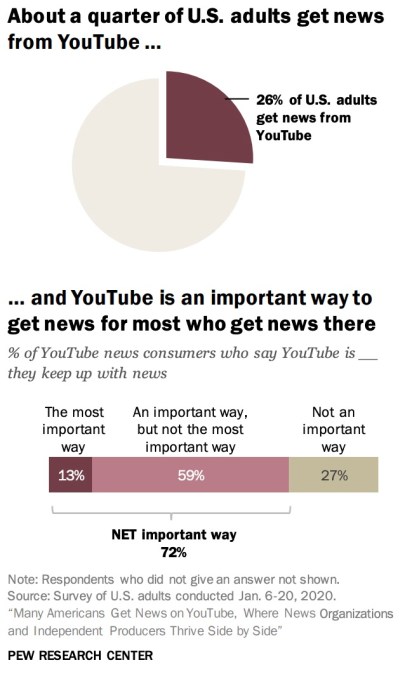
Around a quarter of U.S. adults, or roughly 26%, say they get news by watching YouTube videos, according to a new study from Pew Research Center, which examined the Google-owned video platform’s growing influence over news distribution in the U.S., as well as its consumption. The study, not surprisingly, found that established news organizations no longer have full control over the news Americans watch, as only one-in-five YouTube consumers (23%) said they “often” get their news from channels affiliated with established news organizations. The exact same percentage said they “often” get their news from independent channels instead.

Independent channels in this study were defined as those that do not have a clear external affiliation. A news organization channel, meanwhile, would be a channel associated with an external news organization — like CNN or Fox News, for instance.

These two different types of news channels are common, Pew found, as 49% of popular news channels are affiliated with a news organization, while 42% are not.

A small percentage (9%) were those from “other” organizations publishing news, including government agencies, research organizations and advocacy organizations.

Image Credits: Pew Research

To determine its findings, Pew Research ran a representative panel survey of 12,638 U.S. adults from January 6-January 20, 2020.

This study found that a majority, or 72%, of Americans said YouTube was either an important (59%) or the most important (13%) way they get their news. Most also said they didn’t see any big issues with getting their news from the site, but they did express some moderate concern about misinformation, political bias, YouTube’s demonetization practices and censorship.

Image Credits: Pew Research

Republicans and independents who lean Republican were more likely to say censorship, demonetization and political bias were YouTube’s biggest problems, while Democrats and independents who lean Democrat were more likely to say the biggest problems were misinformation and harassment.

A second part of the research involved content analysis of the 377 most popular YouTube news channels in November 2019 and the content of YouTube videos published by the 100 channels with the highest median of views in December 2019. This was performed by a combination of humans and computational methods, says Pew.

The analysis discovered that more than four-in-ten (44%) popular YouTube channels can be characterized as “personality-driven,” meaning the channel is oriented around an individual. This could be a journalist employed by an established news organization or it could be an independent host.

However, it’s more often true of the latter, as 70% of independent channels are centered around an individual, often a “YouTuber” who has gained a following. Indeed, 57% of independent channels are YouTuber-driven versus the 13% centered around people who were public figures before gaining attention on YouTube.

Image Credits:

The study also looked into other aspects of the YouTube news environment and the topics being presented.

According to YouTube news consumers themselves, a clear majority (66%) said watching YouTube news videos helped them to better understand current events; 73% said they believe the videos to be largely accurate, and they tend to watch them closely (68% do) instead of playing them in the background.

Around half (48%) said they’re looking for “straight reporting” on YouTube — meaning, information and facts only. Meanwhile, 51% said they are primarily looking for opinions and commentary.

In response to an open-ended question about why YouTube was a unique place to get the news, the most common responses involved those related to the content of the videos — for instance, that they included news outside the mainstream or that they featured many different opinions and views.

Image Credits: Pew Research

Pew also examined how often news channels mentioned conspiracy theories, like those related to QAnon, Jeffrey Epstein and the anti-vax movement.

An analysis of nearly 3,000 videos by the 100 most viewed YouTube channels in December 2019 found that 21% of videos by independent channels mentioned a conspiracy theory, compared with just 2% of those from established news organizations. QAnon was the most commonly referenced conspiracy theory, as 14% of videos from independent channels had discussed it, compared with 2% of established news organizations.

Independent channels were also about twice as likely as established news organizations to present the news with a negative tone.

Overall, the videos from the top 100 most viewed YouTube news channels assessed in December 2019, were neither too negative or positive (69%). But broken down by type, 37% of videos on the independent channels were negative, compared with 17% for established news organizations. Negative videos were more popular, too. Across all channels, negative videos averaged 184,000 views compared with 172,000 for neutral or mixed tone videos and 117,000 views for positive videos.

Image Credits: Pew Research

Meanwhile, videos about the Trump administration made up the largest share of views in December 2019, as roughly a third (36%) were about the impeachment and 31% were about other domestic issues, like gun control, abortion or immigration. Another 9% were about international affairs. Videos about the Trump administration saw around 250,000 average views compared with videos on other topics, which averaged 122,000 views. Trump was the most common video focus in about a quarter of the videos studied, or 24%.

Videos about the 2020 elections, which at the time were centered around the Democratic primary, were the topic of just 12% of news videos, by comparison.

Image Credits: Pew Research

The study also examined how YouTube news channels presented themselves. It found that the vast majority don’t clearly state a political ideology even when the content of their videos makes it clear they have an ideological slant.

Only around 12% of YouTube news channels presented their political ideology in their description. Of those, 8% were right-leaning and 4% were left-leaning. Independent news channels were more likely to present themselves using partisan terms and more likely to say they leaned right.

The demographics of the typical YouTube news consumer was a part of the study, too. Pew Research found the news video viewers were more likely to be young and male, and less likely to be White, compared with U.S. adults overall. About a third (34%) are under the age of 30, compared with 21% of all U.S. adults; 71% are under 50, compared with 55% of U.S. adults overall.

And 58% of YouTube news consumers are more likely to be male, compared with 48% of U.S. adults overall. Half (50%) are White, 14% are Black and 25% are Hispanic. In the U.S., 63% of adults are White, 12% are Black and 16% are Hispanic.

The full study is available via the Pew Research Center website.

Let’s block ads! (Why?)

Source: https://techcrunch.com/2020/09/28/a-quarter-of-u-s-adults-now-get-news-from-youtube-pew-research-study-finds/?utm_source=feedburner&utm_medium=feed&utm_campaign=Feed%3A+Techcrunch+%28TechCrunch%29
Droolin’ Dog sniffed out this story and shared it with you.
The Article Was Written/Published By: Sarah Perez


! #Headlines, #Journalism, #Newsfeed, #TechCrunch, #TechNews, #YouTube, #News, #Politics, #Science, #Trump

Friday, September 18, 2020

TikTok and WeChat will be banned in the U.S. from Sunday

GettyImages-1177990254.jpg?w=616

The Commerce Department announced this morning that it will require mobile app stores to remove popular social media apps TikTok and WeChat. New users will not be able to download these apps, and while existing users will still be able to use their existing apps installed on their phones, new updates will not be allowed to be installed. In addition, the Commerce Department is also banning any payment transactions through WeChat within the United States.

The bans will go into force Sunday, September 20.

Those decisions are in line with an executive order signed by President Trump on August 6, which put ByteDance and Tencent, the respective owners of TikTok and WeChat, on notice of the government’s intention to block access to their products over purported concerns about national security.

That executive order precipitated the last few weeks of feverish dealmaking to avoid a shutdown of TikTok, discussions that remain on-going and are not finalized. As of today, Oracle and what looks like Walmart are still negotiating with the White House, Treasury Department, and ByteDance to come to a deal that will be acceptable to the president. China also has authority to approve a sale of TikTok.

Over the last few weeks, the administration has promoted a policy known as “Clean Network” designed to eliminate foreign interference in applications and cloud infrastructure that powers American technology. That policy calls for the removal of certain apps, data sovereignty to onshore American user data to the United States, mobile network infrastructure built from “clean” equipment, and a host of other measures to create a “clean” computing environment for U.S. citizens. While those policies are generally written broadly, their clear target has been China, based on speeches from administration officials.

TikTok and WeChat are not the only app removals announced over night. In India, one of the most popular payment apps in the country — Paytm — has been removed from Google’s Play Store for “repeat policy violations.” The app has tens of millions of monthly users. In late June, the country also announced a list of 59 apps developed by Chinese companies that would be banned, including TikTok.

Such national fights over the future of technology have increasingly come to a head as tech drives a larger segment of the global economy and increasingly becomes intertwined with competing national interests.

Let’s block ads! (Why?)

Source: https://techcrunch.com/2020/09/18/tiktok-and-wechat-will-be-banned-in-the-u-s-from-sunday/?utm_source=feedburner&utm_medium=feed&utm_campaign=Feed%3A+Techcrunch+%28TechCrunch%29
Droolin’ Dog sniffed out this story and shared it with you.
The Article Was Written/Published By: Danny Crichton


! #Headlines, #Apps, #China, #Newsfeed, #TechCrunch, #TechNews, #TechnologyNews, #Trump, boycott, TikTok, #News, #Politics, #WorldNews

Tuesday, September 15, 2020

Dynetics has built a full-scale test version of its lunar human lander for NASA

dyn-banner-de7036bf03.jpg?w=717

One of the three companies chosen by NASA to create a Human Landing System (HLS) for NASA has completed a key step by building a full-scale test article of its lander for its team and NASA to evaluate and review. The Dynetics HLS is roughly the size of the Apollo Moon lander, but it’s laid out very differently, as you can see in the image above.

Dynetics provided a brief overview of the test article and its purpose in a video introduction on Tuesday. As you can see in the walkthrough below, it’s essentially a true-to-size 3D model that includes modular, re-arrangeable components. These don’t include actual working electronics or anything – they’re more like lego blocks that NASA and the Dynetics engineers working on the product can use together to ensure that the HLS design works well ergonomically and functionally for the astronauts who will eventually be using it to make the trip down to the lunar surface.

The components of this test article include the crew module where astronauts will be living and working during their stay at the Moon, as well as the tanks that will hold the propellant fo r the ascent and descent phases of its flight, a autonomous cargo platform, and the tall solar arrays that will help power the spacecraft. Dynetics and its subcontractor LSINC created the mock vehicle in just three months after being awarded the contract by NASA.

The goal for Dynetics, as well as for Blue Origin and SpaceX, is to compete with one another for the initial contract to take humans to the surface of the Moon for NASA’s initial human landing as part of its Artemis program, currently scheduled for 2024. Earlier this week, Blue Origin announced that it had passed a critical initial design requirements review, and Dynetics says it has accomplished the same. Blue Origin also delivered a full scale test article of its own to NASA back in August.

Let’s block ads! (Why?)

Source: https://techcrunch.com/2020/09/15/dynetics-has-built-a-full-scale-test-version-of-its-lunar-human-lander-for-nasa/?utm_source=feedburner&utm_medium=feed&utm_campaign=Feed%3A+Techcrunch+%28TechCrunch%29
Droolin’ Dog sniffed out this story and shared it with you.
The Article Was Written/Published By: Darrell Etherington


! #Headlines, #Newsfeed, #Space, #TechCrunch, #TechNews, #TheMoon, NASA, solar power, #News, #Politics, #Science, #ThePlanet

Thursday, September 10, 2020

NASA is looking to buy Moon dirt from private companies – no return shipping required

slide1_1_pc.jpg?w=764

NASA wants to procure samples of lunar soil from private contractors, the agency announced today in a blog post by NASA Administrator Jim Bridenstine. This is part of the agency’s overall ambitions around returning humans to the Moon by 2024, and establishing a sustained human research presence there. NASA is asking for proposals from commercial space companies to offer up their proposals for collecting a small amount of rocks or dirt from “any location” on the Moon’s surface, along with a photo of the collection process and resulting sample.

The proposals ask only that private companies collect the material – they’re not responsible for actually getting it back to Earth for study. They will need to do an “in-place” handoff of the collected sample to the agency – on the Moon, but that’s much less of a challenge than shipping it all the way back here, and the specifics around retrieval will be handled by NASA “at a later date.”

Some stipulations and specifics to keep in mind: NASA wants the retrieval of the materials to take place before 2024, along with the ownership handoff. This is also open to companies internationally, so it’s not just for U.S. private space companies, and it’s also possible that NASA will make more than one award under the program. In terms of payouts, winning companies will get 10 percent o the total contract value at the time of the award, another 10 percent at launch of their retrieval vehicle, and the final 80 percent once the sample is collected and handed off.

There are a number of companies working on extraterrestrial resource collection, so this call could get some interesting applicants. It’s worth noting that this is separate from NASA’s Commercial Lunar Payload Services program, which offers contracts for transporting experiments to the lunar surface aboard landers – but you can bet some of those startups and companies will be vying for the chance to use said landers and robotic rovers in development to pick up some Moon dirt for NASA.

Let’s block ads! (Why?)

Source: https://techcrunch.com/2020/09/10/nasa-is-looking-to-buy-moon-dirt-from-private-companies-no-return-shipping-required/?utm_source=feedburner&utm_medium=feed&utm_campaign=Feed%3A+Techcrunch+%28TechCrunch%29
Droolin’ Dog sniffed out this story and shared it with you.
The Article Was Written/Published By: Darrell Etherington


! #Headlines, #Newsfeed, #Space, #TechCrunch, #TechNews, #TheMoon, NASA, #News, #Politics, #Science

Tuesday, September 8, 2020

Lucid Motors’ all-electric Air will start below $80,000

Lucid-Air-Exterior-7.jpg?w=600

After months of teasers and announcements, Lucid Motors will finally reveal its first all-electric luxury sedan, the Air, during a live stream on September 9. But of course, the day before the big reveal, a little bit of news has trickled out.

Lucid Motors has previously alluded that it will offer a high-end variant of the Air. That flagship variant, called the Dream, is expected to cost $169,000 (or $161,500 after federal tax credits are accounted for), according to a report by Bloomberg. The report said Lucid will produce a Grand Touring variant that will be priced in the low $130,000s after federal tax credits, as well as a sub-$100,000 Touring model.

TechCrunch has learned there will be a fourth and cheaper base model priced under $80,000. It’s unclear just how much cheaper the base version of the Air will be or when it will be available; automakers often start producing their most expensive models first. If Lucid follows that strategy, the base version won’t be available until late 2021 or 2022.

A base model Air priced under $80,000 would put it in direct competition with the Tesla Model S. The base Tesla Model S has a range of 402 miles and costs $74,990. Lucid Motors has previously disclosed that Air has an estimated U.S. EPA range of 517 miles, although it’s possible that the base model will have a lower range. If the EPA validates that range, the Air would blow past every other EV on the road today, including Tesla. And if the base model has a range above 400 miles, it could further dampen sales of the Tesla Model S. Most of Tesla’s sales come from the Model 3.

Lucid has already disclosed a number of other details about its upcoming electric sedan, including that it is capable of a 9.9-second quarter mile, making it faster than most production cars on the market. But what might be more attractive to prospective customers is the vehicle’s advanced driver assistance system, which is designed to support hands-free driving on highways.

Earlier this summer, Lucid revealed that the Air will be loaded with 32 sensors, a driver-monitoring system and an Ethernet-based architecture for its advanced driver assistance system, which it calls DreamDrive. The total number isn’t what matters. The type and location — and of course, the software — does. So far, Lucid has just provided details on the hardware.

The Air will come with one lidar, radar, cameras and ultrasonic sensors. Lidar — the light detection and ranging radar that measures distance using laser light to generate a highly accurate 3D map of the world around the car — is a noteworthy inclusion. The sensor is typically used on autonomous vehicles, not the production cars, trucks and SUVs that consumers will buy and drive. Lucid said its long-range lidar sensor will be placed in the front of the vehicle.

Lucid has previously said it will produce the Air at its new Arizona factory in early 2021, about three months later than expected due to a slowdown caused by COVID-19. Construction resumed in early June at its factory in Casa Grande, Arizona. At the time, the company said it was on target to complete phase one this year. Lucid Motors has also restarted vehicle development work at its California facility, which was briefly delayed due to shelter-in-place orders.

Let’s block ads! (Why?)

Source: https://techcrunch.com/2020/09/08/lucid-motors-all-electric-air-will-start-below-80000/?utm_source=feedburner&utm_medium=feed&utm_campaign=Feed%3A+Techcrunch+%28TechCrunch%29
Droolin’ Dog sniffed out this story and shared it with you.
The Article Was Written/Published By: Kirsten Korosec


! #Headlines, #Cars, #ElectricVehicles, #Newsfeed, #TechCrunch, #TechNews, #TechnologyNews, #Coronavirus, #Health, #News, #Politics

Thursday, July 23, 2020

China’s first Mars rover is en route to the Red Planet after successful launch of Tianwen-1

Tf6BsWZHTUjsNSCZExEh3D-1200-80.jpeg?w=71

China successfully launched a combination Mars orbiter and rover early this morning, using a Long March 5 rocket that took off from Wenchang Satellite Launch Center on Hainan Island at 12:41 AM EDT. The Tianwen-1 payload it carries represents China’s first full-scale Mars exploration mission, after a prior partial attempt with a orbital Mars satellite called Yinghuo-1 failed to leave Earth’s orbit in 2011.

This is a major effort not just for China, but also for extra-terrestrial planetary exploration in general, because it includes the combination effort of both the lander and rover in one combined mission, with the plan to deploy the rover on land and have it communicate with the orbiter as it makes its way around Mars all in one trip.

Tianwen-1 is the second Mars mission to take off this month, following a successful launch earlier this week by the UAE from Japan atop a Japanese MHI rocket. That mission, ‘Hope,’ carried an orbiter designed to take atmospheric readings of the Red Planet’s atmosphere.

China’s mission includes a planned 90-day excursion for the solar-powered rover it carries, which will employ various instruments on board to take samples and readings including multispectral photography, surface composition, weather readings and magnetic field information. The orbiter will also use its own cameras and instruments to gather info, including spectrometer readings, radar and photography, and will also act as a relay station to get data from the rover back to Earth.

There’s still one more mission to Mars yet to go before this year’s close approach (the time when Earth and Mars are closest to each other in their relative solar orbits) ends: NASA’s Perserverance Mars rover launch. That’s set to take off on July 30, weather and conditions permitting. Perseverance is the successor to NASA’s Curiosity rover, and includes a number of new scientific instruments to seek evidence of ancient life, and attempt to gather samples to actually return to Earth. It’ll also carry a small autonomous helicopter, which will hopefully become the first powered aircraft to take off from the surface of Mars when it reaches the red planet.

Tianwen-1 is expected to reach Mars next February, after a multi-month passage, which is the shortest trip possible between the two planets based on their relative orbits.

Let’s block ads! (Why?)

Source: https://techcrunch.com/2020/07/23/chinas-first-mars-rover-is-en-route-to-the-red-planet-after-successful-launch-of-tianwen-1/?utm_source=feedburner&utm_medium=feed&utm_campaign=Feed%3A+Techcrunch+%28TechCrunch%29
Droolin’ Dog sniffed out this story and shared it with you.
The Article Was Written/Published By: Darrell Etherington


! #Headlines, #China, #Mars, #Newsfeed, #Science, #Space, #TechCrunch, #TechNews, #TechnologyNews, #ThePlanet, #News, #Politics, #WorldNews

Friday, July 10, 2020

What do investors bidding up tech shares know that the rest of us don’t?

The biggest story to come out of the post-March stock market boom has been explosive growth in the value of technology shares. Software companies in particular have seen their fortunes recover; since March lows, public software companies’ valuations have more than doubled, according to one basket of SaaS and cloud stocks compiled by a Silicon Valley venture capital firm.

Such gains are good news for startups of all sizes. For later-stage upstarts, software share appreciation helps provide a welcoming public market for exits. And, strong public valuations can help guide private dollars into related startups, keeping the capital flowing.


The Exchange explores startups, markets and money. You can read it every morning on Extra Crunch, and now you can receive it in your inbox. Sign up for The Exchange newsletter, which drops every Friday starting July 24.


For software-focused startup companies, especially those pursuing recurring revenue models like SaaS, it’s a surprisingly good time to be alive.

Indeed, after COVID-19 hit the United States, layoffs and rising software sales churn were key, worrying indicators coming out of startup-land. Since then, the data has turned around.

As TechCrunch reported in June, startup layoffs have declined and software churn has recovered to the point that business and enterprise-focused SaaS companies are on the bounce.

But instead of merely recovering to near pre-COVID levels, software stocks have continued to rise. Indeed, the Bessemer Cloud Index (EMCLOUD), which tracks SaaS firms, has set an array of all-time highs in recent weeks.

There’s some logic to the rally. After speaking to venture capitalists over the past few weeks, notes from EQT Ventures‘ Alastair Mitchell, Sapphire’s Jai Das, and Shomik Ghosh from Boldstart Ventures paint the picture of a possibly accelerating digital transformation for some software companies, nudged forward by COVID-19 and its related impacts.

The result of the trend may be that the total addressable market (TAM) for software itself is larger than previously anticipated. Larger TAM could mean bigger future sales for and more substantial future cash flows for some software companies. This argument helps explain part of the market’s present-day enthusiasm for public tech equities, and especially the shares of software companies.

We won’t be able explain every point that Nasdaq has gained. But the TAM argument is worth understanding if we want to grok a good portion of the optimism that is helping drive tech valuations, both private and public.

Let’s block ads! (Why?)

Source: https://techcrunch.com/2020/07/10/what-do-investors-bidding-up-tech-shares-know-that-the-rest-of-us-dont/?utm_source=feedburner&utm_medium=feed&utm_campaign=Feed%3A+Techcrunch+%28TechCrunch%29
Droolin’ Dog sniffed out this story and shared it with you.
The Article Was Written/Published By: Alex Wilhelm


! #Headlines, #BusinessNews, #Economy, #Money, #Newsfeed, #TechCrunch, #TechNews, #TechnologyNews, #Coronavirus, #Health, #News, #Politics

Tuesday, June 30, 2020

YouTube bans David Duke, Richard Spencer and other white nationalist accounts

GettyImages-1149449083.jpg?w=600

YouTube just took action against a collection of controversial figures synonymous with race-based hate, kicking six major channels off its platform for violating its rules.

The company deleted six channels on Monday: Richard Spencer‘s own channel and the affiliated channel for the National Policy Institute/Radix Journal, far right racist pseudo-science purveyor Stefan Molyneux, white supremacist outlet American Renaissance and affiliated channel AmRenPodcasts and white supremacist and former Ku Klux Klan leader David Duke.

“We have strict policies prohibiting hate speech on YouTube, and terminate any channel that repeatedly or egregiously violates those policies. After updating our guidelines to better address supremacist content, we saw a 5x spike in video removals and have terminated over 25,000 channels for violating our hate speech policies,” a YouTube spokesperson said in a statement provided to TechCrunch.

The company says that the channels it removed were repeat or “egregious” violators of the platform’s rules against leveraging YouTube videos to link to off-platform hate content and rules prohibiting users from making claims of inferiority about a protected group.

YouTube’s latest house-cleaning of far-right and white nationalist figures follows the suspension of Proud Boys founder Gavin McInnes earlier this month. Some of the newly-booted YouTube account owners turned to still-active Twitter accounts to complain about losing their YouTube channels Monday afternoon.

The same day that YouTube enforced its rules against a high-profile set of far-right accounts, both Twitch and Reddit took their own actions against content that violated their respective rules around hate. The Amazon-owned gaming streaming service suspended President Trump’s account Monday, citing comments made in two Trump rallies that aired there, one years-old and one from the campaign’s recent Tulsa rally. And after years of criticism for its failure to stem harassment and racism on, Reddit announced that it would purge 2,000 subreddits, including r/The_Donald, the infamously hate-filled forum founded as Trump announced his candidacy.

Let’s block ads! (Why?)

Source: https://techcrunch.com/2020/06/29/youtube-ban-stefan-molyneux-david-duke-white-nationalism/?utm_source=feedburner&utm_medium=feed&utm_campaign=Feed%3A+Techcrunch+%28TechCrunch%29
Droolin’ Dog sniffed out this story and shared it with you.
The Article Was Written/Published By: Taylor Hatmaker


! #Headlines, #Censorship, #Racism, #TechCrunch, #TechNews, #YouTube, #News, #Newsfeed, #Politics, #Trump

Monday, June 22, 2020

To create the jobs our economy needs, the US must expand immigration

GettyImages-1160097088.jpg?w=600

Sophie Alcorn
Contributor

Sophie Alcorn is the founder of Alcorn Immigration Law in Silicon Valley and 2019 Global Law Experts Awards’ “Law Firm of the Year in California for Entrepreneur Immigration Services.” She connects people with the businesses and opportunities that expand their lives.

As a second-generation immigration attorney, I’ve spent three decades helping people navigate the U.S. immigration system. At my Silicon Valley firm, we support tech entrepreneurs and business owners seeking business-nurturing opportunities that only the U.S. can offer.

My clients are innovators with big American dreams, founding companies that will create thousands of new jobs — jobs that our economy sorely needs.

President Trump announced his intent to suspend all U.S. immigration amid the COVID-19 pandemic and new restrictions may be coming any day. Severely limiting immigration would be a grave mistake.

The success of America is in large part due to the ingenuity of global transplants. The world has no shortage of brilliant scientists, inventors and entrepreneurs. For decades, they have sought to bring their ideas and their labor to the U.S. We are short-sighted to turn them away.

We are in a greater economic crisis than any of us have ever experienced. As of this writing, more than 40 million Americans have filed unemployment claims. We can create jobs through innovation and immigration spurs innovation. According to the U.S. Treasury Department, immigrants are measurably more likely than nonimmigrants to start businesses. Immigrants founded 25% of the venture-backed American companies that went public between 1990 and 2005, and 33% of those that have gone public since 2006. More than half of America’s “unicorn” start-ups — those valued at $1 billion or more — are immigrant-founded.

Contrary to what Trump claims, America is already unduly hostile to those seeking to put down roots here and live their American dream. Just one example: Although many of the world’s promising minds come to the U.S. to pursue advanced degrees, they overwhelmingly don’t have a way to stay here once their schooling is done. Students who aspire to start businesses here after graduating are forced instead to leave our shores and start over from scratch.

Even for the most starry-eyed innovators, the American dream cannot be attained. Many of the world’s best and brightest, after hitting the U.S. immigration brick wall, will end up being wooed away to other countries. They will take their companies public there, contributing new jobs and tax revenue in their second-choice homes. Meanwhile, the U.S. continues to bleed jobs, with no end in sight to either the pandemic or its cascading economic effects.

Alternatively, for people hoping to enter the U.S. having already embarked on their careers, the coveted H-1B visa is often the only option. Available only to those with specialized skills and a job offer from an American employer, H-1B visas can provide a springboard for ambitious innovators wishing to establish themselves professionally in the U.S. But getting one of these visas requires literally winning a lottery, and the lucky few who are selected have to wait months to actually come here, testing the patience of the employers on whom their visas depend.

Ambitious entrepreneurs could go anywhere in the world. Many countries bend over backward to welcome them, with immigration perks and financial grants to attract start-up founders. But even though we try to shut them out, the world’s best entrepreneurs still fight to come here — with good reason. There are Silicon Alleys and Silicon Beaches elsewhere, but none of them have the same concentration of capital, mentors and skilled professionals. For people who want to start unicorn companies that are really going to change the world, the U.S. has the necessary ingredients to take their ideas to scale — including, now, a rapidly growing pool of job-seekers eager to fill new positions. Additionally, immigrant founders tend to be more open to hiring diverse workforces, thus increasing BIPOC recruitment and retention efforts at scale.

Perhaps in a different climate, we could afford to turn up our noses at innovation from overseas. But not anymore. To truly protect our country, revitalize our economy and create opportunity for all, we would be wise to open our borders wider, not slam them shut.

Let’s block ads! (Why?)

Source: https://techcrunch.com/2020/06/22/to-create-the-jobs-our-economy-needs-the-us-must-expand-immigration/?utm_source=feedburner&utm_medium=feed&utm_campaign=Feed%3A+Techcrunch+%28TechCrunch%29
Droolin’ Dog sniffed out this story and shared it with you.
The Article Was Written/Published By: Walter Thompson


! #Headlines, #Employment, #Immigration, #Jobs, #TechCrunch, #TechNews, unemployment, #Coronavirus, #Health, #News, #Newsfeed, #Politics, #Science, #ThePlanet, #Trump, #WorldNews

Tuesday, June 9, 2020

Microsoft employees call for company to cancel its police contracts

gettyimages-928059862.jpeg?w=600

In a new letter addressed to executive leadership, a group of Microsoft employees is demanding that the Seattle-area company end its existing law enforcement contracts.

As reported by OneZero, the letter, sent via email, emerged out of a Facebook group for young employees at the company. It addresses Microsoft CEO Satya Nadella and Executive Vice President Kurt DelBene directly and was copied to 250 supporters. In the past, Microsoft employees have organized other kinds of activism through the same Facebook group, which now has almost 10,000 members.

Among the demands, the email calls for the company to pull its contracts with law enforcement agencies, support the “defunding and demilitarization” of the Seattle Police Department and throw its support behind Black Lives Matter Seattle. The letter also requests that managers at the company relax productivity expectations and implement a four-day work week amid the dual crises of COVID-19 and ongoing civil unrest protesting the police killing of George Floyd, an unarmed Black man in Minneapolis.

The letter cites a number of local instances of police brutality and calls for “coworkers, managers, and leaders who live miles away outside of Seattle” to bridge the gap, connecting to the state-sanctioned violence unfolding in Seattle’s urban center, including “24/7 helicopter noise, teargassing, flashbanging, rubber bullets, gun shots, and vans/buses filled with armed law enforcement.”

“We need awareness and empathy across every level of management asap so that the burden of educating our coworkers doesn’t fall on those of us in the middle of a public safety and mental health crisis,” the authors urge.

Last week, Nadella outlined the company’s planned response to ongoing racial injustice in an email to employees, noting that the company would “look inside, examine our organization, and do better.” In the letter, Nadella committed to $1.5 million in additional donations to six racial justice and policing reform initiatives, including the Minnesota Freedom Fund, the Black Lives Matter Foundation and the Innocence Project.

Let’s block ads! (Why?)

Source: https://techcrunch.com/2020/06/09/microsoft-letter-law-enforcement-black-lives-matter/?utm_source=feedburner&utm_medium=feed&utm_campaign=Feed%3A+Techcrunch+%28TechCrunch%29
Droolin’ Dog sniffed out this story and shared it with you.
The Article Was Written/Published By: Taylor Hatmaker


! #Headlines, #Employment, #Jobs, #Microsoft, #Police, #TechCrunch, #TechNews, #Coronavirus, #Health, #News, #Newsfeed, #Politics

Thursday, May 28, 2020

Amazon says it will offer full-time jobs to 125,000 temporary workers

GettyImages-1124819781.jpg?w=605

In a blog post today, Amazon announced plans to offer permanent jobs to around 70% of the 175,000 temporary workers it brought on to meet demand amid a COVID-19-fueled surge. Initially filled as seasonal positions, the company will be transferring 125,000 people to full-time roles next month, as the pandemic-fueled push theoretically dies down.

Those roles will earn workers a minimum wage of $15 and hour (after pushback from lawmakers like Bernie Sanders) and access to some training programs designed to help them work their way up at the company. The full-time jobs will kick in the same month Amazon winds down its $2 an hour hazard pay for workers.

Amazon has been the subject of criticism for its handling of the COVID-19 crisis, including letters from senators and attorneys general aimed at getting a better picture of its worker health policies, along with numbers of employees who have been infected or died from the novel coronavirus.

Another asked the company to offer insight into why the company had fired a number of staff who had been vocally critical of its policies. Amazon has denied any wrong doing in all of this and insisted that COVID-19 rates among staff are lower than the general population.

This latest move comes amid the worst U.S. unemployment rate since the Great Depression. This week, an additional 2.1 million Americans applied for unemployment, bringing the total up to 41 million since the beginning of the pandemic. Economists are hopeful that reopening sectors of the country will help reverse those figures, assuming that such actions don’t lead to massive spikes in COVID-19 cases and deaths.

Let’s block ads! (Why?)

Source: https://techcrunch.com/2020/05/28/amazon-says-it-will-offer-full-time-jobs-to-125000-temporary-workers/?utm_source=feedburner&utm_medium=feed&utm_campaign=Feed%3A+Techcrunch+%28TechCrunch%29
Droolin’ Dog sniffed out this story and shared it with you.
The Article Was Written/Published By: Brian Heater


! #Headlines, #Amazon, #Employment, #Jobs, #Shutdown, #TechCrunch, #TechNews, bernie sanders, #Coronavirus, #Health, #News, #Newsfeed, #Politics