Showing posts with label census. Show all posts

Monday, October 4, 2021

States rev up redrawing congressional maps

1633272293452.jpg

A number of states have proposed or finalized new congressional district maps in the past week. The recurrent theme: protecting incumbents rather than expanding majorities.

Why it matters: The flurry of activity is just the start of the high-stakes process that has the potential to affect congressional power for a decade. The biggest states are still to come — as well as deadlines, lawsuits and the potential for lots of court-drawn midterm maps.


  • “The narrative that is emerging is of incumbents protecting themselves, not necessarily trying to maximize their party’s fortunes,” Nate Persily, a redistricting expert at Stanford Law School, told Axios. “But there’s still a lot of territory that remains.”
  • Republicans are currently expected to net one to two seats through redistricting, according to the Cook Political Report’s Dave Wasserman, but, “we’re also on track for far fewer competitive seats.”

The details: Six states only have one district, so they don’t have to go through redistricting. Three states have already completed new maps for the next decade, including in Oregon — where Democrats have the advantage to win the state’s newly gained seat. The other two are Maine and Nebraska.

  • Texas’s proposed map would likely net two Republican seats. It does not include a Hispanic-majority district, which experts say will likely result in a lawsuit.
  • Colorado’s final proposed map includes one new competitive seat, giving Republicans a shot at equal House representation with Democrats in a state that voted for Joe Biden by 13 points in 2020.
  • The Ohio state legislature missed an initial redistricting deadline, allowing Republicans more time to gerrymander. But GOP legislators would have to prove to the state Supreme Court their map doesn’t favor one party — or risk a court-drawn one that could cost them seats.
  • Michigan has an independent commission in charge of drawing maps with partisan fairness. It’s not an easily-defined metric. The state’s geography favors Republicans, but “the question is whether the commission consciously uses partisanship to try to draw more Democratic seats and achieve parity,” Wasserman told Axios.

By the numbers: Princeton University and RepresentUs have launched an in-depth grading system for proposed and enacted maps — scoring them on partisan fairness, competitiveness and geographic features.

  • So far, they’ve given an overall “A” to Colorado, “B” to Ohio, “C” to Georgia and “F” to Texas maps.
  • Their analysis shows states drawing large numbers of uncompetitive districts, with 60-70% of voters favoring the party in charge of redistricting, Joe Kabourek, RepresentUs senior campaign director, and Adam Podowitz-Thomas, the Princeton Gerrymandering Project’s senior legal strategist, told Axios.
  • At the same time, states have generally been able to avoid failing the groups’ tests for suspicious geographic manipulation like county-splitting. New technology has made it easier to create districts meeting certain requirements that still benefit a given party.

What we’re watching: A major, unanswered question is whether Democrats try to hold on to their majority through gerrymandering in New York and Illinois.

  • The Illinois map is expected to give Democrats two extra seats, Wasserman said, and the New York map could be key to the Democrats holding onto control of the House itself.
  • What Republicans do in big states North Carolina and Florida is where they control the process— and whether they propose more aggressive maps in Georgia than they initially did.

Source: https://www.axios.com/redistricting-gerrymandering-midterm-congress-56c493ba-ac11-493f-bc8f-361e1688ad34.html
Droolin’ Dog sniffed out this story and shared it with you.
The Article Was Written/Published By: Stef W. Kight


! #Headlines, #Axios, #Newsfeed, #Politics, census, gerrymandering, new york nyc NY nypd nyfd, #News

Wednesday, September 29, 2021

Colorado remap plan creates new competitive district

denver_skyline_getty.jpg

A new U.S. House district awarded to Colorado after a decade of rapid growth will set Democrats and Republicans up for a competitive showdown in the northern suburbs of Denver after the state’s redistricting commission ca…

Source: https://thehill.com/homenews/state-watch/574479-colorado-remap-plan-creates-new-competitive-district
Droolin’ Dog sniffed out this story and shared it with you.
The Article Was Written/Published By: Reid Wilson


! #Headlines, #Colorado, #Elections, #Newsfeed, #Political, #Politics, census, #News

Tuesday, August 24, 2021

Virginia commission will redraw districts from scratch

virginia_flag_04272020_1.jpg

Virginia’s Redistricting Commission voted on Monday to redraw the commonwealth’s congressional and state legislative districts from scratch, marking a victory for anti-gerrymandering advocates.The 16-person commiss…

Source: https://thehill.com/homenews/state-watch/569157-virginia-commission-will-redraw-districts-from-scratch
Droolin’ Dog sniffed out this story and shared it with you.
The Article Was Written/Published By: Julia Manchester


! #Headlines, #Elections, #Government, #Newsfeed, #Political, #Politics, census, gerrymandering, Virginia, #News

Tuesday, August 17, 2021

Wisconsin Republicans seek to intervene in Democrats’ redistricting case

statecapitolbuildings_wisconsin_madison_

Republican lawmakers in Wisconsin on Monday took initial steps to intervene in a Democratic-led lawsuit over the state’s voting maps, teeing up a potential partisan court clash over the once-per-decade redistri…

Source: https://thehill.com/regulation/court-battles/568152-wisconsin-republicans-seek-to-intervene-in-democrats-redistricting
Droolin’ Dog sniffed out this story and shared it with you.
The Article Was Written/Published By: John Kruzel


! #Headlines, #Elections, #Newsfeed, #Political, #Politics, census, gerrymandering, Wisconsin, #News

Sunday, August 15, 2021

New Census data to show US diversifying at fastest rate ever

03192020_census_getty.jpg

Data to be released Thursday by the Census Bureau is likely to show the U.S. is diversifying at the fastest rate in the nation’s history, even as overall population growth slows to the most sluggish pace since the c…

Source: https://thehill.com/homenews/state-watch/567383-new-census-data-to-show-us-diversifying-at-fastest-rate-ever
Droolin’ Dog sniffed out this story and shared it with you.
The Article Was Written/Published By: Reid Wilson


! #Headlines, #Diversity, #Government, #Newsfeed, #People, #Political, census, #News

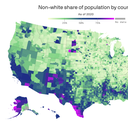
More than 400 U.S. counties are now minority white

1628875897120.png

Data: U.S. Census Bureau; Map: Connor Rothschild and Naema Ahmed/Axios

White, non-Hispanic Americans now account for less than six in 10 people in the U.S. — a more precipitous drop over the past decade than experts expected — and they’re no longer the racial-ethnic majority in 13% of U.S. counties.

The big picture: America’s identity is shifting with its population.


  • Redistricting will decide how partisan power is divvied up for the next decade — but in some states, those politically driven decisions may obscure these deeper statistical trends.

By the numbers: White, non-Hispanic Americans are about 58% of the U.S. population, according to data from the 2020 census released on Thursday. That’s lower than the estimates of 60%, and it compares with about 64% in 2010.

  • They are no longer the racial-ethic majority in 400 of the nation’s 3,100+ counties and county equivalents, up from 340 a decade ago.

Be smart: The pace of the decline may reflect a combination of actual change plus new ways the Census Bureau is asking about demographic identity to capture Americans who identify with more than one race.

The intrigue: Non-whiteness and diversity are actually two different measures. The Census also has developed a way to calculate diversity based on how likely it is that two people chosen at random within a boundary will be of different races or ethnicities.

  • The least diverse state, by this measure, is Maine, at 19%. The most diverse is Hawaii, at 76%.

Source: https://www.axios.com/diversity-majority-minority-white-american-census-bd181b53-f170-40b2-9913-dd43363e1aaf.html
Droolin’ Dog sniffed out this story and shared it with you.
The Article Was Written/Published By: Stef W. Kight


! #Headlines, #Axios, #CivilRights, #Diversity, #Government, #Newsfeed, #People, #Politics, census, #News

Thursday, August 12, 2021

Five takeaways from a groundbreaking Census report

people-walking-city_ny_060721getty_censu

The United States is becoming more diverse more quickly than anticipated as minority communities grow while white populations shrink for the first time, the U.S. Census Bureau said Thursday as it released a new trove of d…

Source: https://thehill.com/homenews/state-watch/567669-five-takeaways-from-a-groundbreaking-census-report
Droolin’ Dog sniffed out this story and shared it with you.
The Article Was Written/Published By: Reid Wilson


! #Headlines, #Elections, #Government, #Newsfeed, #People, #Political, #Politics, census, #News

Census shows US growth driven by minorities; white pop falls under 60 percent

ny_051720getty_population-crawl.jpg

The growth in the American population over the last decade was driven entirely by minority communities, according to new data released Thursday by the U.S. Census Bureau, as the number of white Americans declined for the…

Source: https://thehill.com/homenews/state-watch/567605-census-shows-us-growth-driven-by-minorities-white-pop-falls-under-60
Droolin’ Dog sniffed out this story and shared it with you.
The Article Was Written/Published By: Reid Wilson


! #Headlines, #Diversity, #Government, #Newsfeed, #Political, census, #News

Census Bureau data out today will shape the redistricting fight of this decade

4500.jpg?width=1200&height=630&quality=8

Of concern is a 2019 decision that gives lawmakers clearance to manipulate districts for political purposes

Happy Thursday,

Continue reading…

Source: https://www.theguardian.com/us-news/2021/aug/12/census-bureau-data-redistricting-fight-to-vote
Droolin’ Dog sniffed out this story and shared it with you.
The Article Was Written/Published By: Sam Levine in New York


! #Headlines, #Elections, #Government, #Newsfeed, #Politics, #Trending, #Vote, #VoterSuppression, census, gerrymandering, #News

Friday, May 7, 2021

California records first annual population decrease in state history

ca_california_flag.jpg

California’s population declined last year, marking the first time the nation’s largest state has registered a drop since it joined the Union in 1850.The state’s Department of Finance …

Source: https://thehill.com/homenews/state-watch/552369-california-records-first-annual-population-decrease-in-state-history
Droolin’ Dog sniffed out this story and shared it with you.
The Article Was Written/Published By: Reid Wilson


! #Headlines, #California, #Newsfeed, #People, #Political, census, #News

Tuesday, April 27, 2021

On The Trail: Census data kicks off the biggest redistricting fight in American history

dome_captiol_033021gn3_lead.jpg

The first data from the 2020 U.S. census released Monday kicks off a new phase in perhaps the most consequential political battle of the next decade as Republicans and Democrats get to work drawing legislative and congressional district…

Source: https://thehill.com/homenews/campaign/550358-on-the-trail-census-data-kicks-off-the-biggest-redistricting-fight-in
Droolin’ Dog sniffed out this story and shared it with you.
The Article Was Written/Published By: Reid Wilson


! #Headlines, #Congress, #Elections, #Government, #Newsfeed, #People, #Political, #Politics, #VoterSuppression, census, gerrymandering, #News

US census gives Texas, Florida more seats in Congress

AP_21096611383510.jpg?resize=1200%2C630

California and New York lose seats as new US population data shifts voting districts for House of Representatives.

Source: https://www.aljazeera.com/news/2021/4/26/us-census-gives-texas-florida-more-seats-congress
Droolin’ Dog sniffed out this story and shared it with you.
The Article Was Written/Published By:


! #Headlines, #Congress, #Elections, #Government, #Newsfeed, #Political, #Politics, census, new york nyc NY nypd nyfd, #News

Monday, April 26, 2021

Census numbers expected to shift House power to the South, West

dome_capitol_040621gn3_lead.jpg

The U.S. Census Bureau will release the first results of its decennial survey on Monday after a decade of explosive growth in Sun Belt states that will shift power in the House of Representatives.Acting Census Bure…

Source: https://thehill.com/homenews/state-watch/550234-census-bureau-to-release-congressional-apportionment-numbers-as
Droolin’ Dog sniffed out this story and shared it with you.
The Article Was Written/Published By: Reid Wilson


! #Headlines, #Government, #Newsfeed, #Political, #Politics, census, #News

Saturday, April 24, 2021

The redistricting cycle is about to begin

210423-census-getty-773.jpg

The most chaotic year in congressional politics is about to begin.

The U.S. Census Bureau will release the first data from the 2020 census next week, setting in motion the process of redistricting: the scramble to draw new congressional maps in the 43 states with more than one district. And with the House more closely divided than it’s been in two decades, each individual state’s new map could have huge implications on the majority fight.

Strategists in both parties agree Republicans have the advantage. The Midwest and Rust Belt aren’t growing as fast as the Sun Belt, and the congressional districts will be reallocated accordingly. States like Florida, Texas, Arizona and North Carolina will see their delegations grow, while Michigan, Pennsylvania and Illinois shrink. That’s a net benefit to the GOP because Democrats have struggled to increase their statewide footprint in many of the places that are gaining representation.

This reapportionment data normally arrives in late December at the end of every decade, but the pandemic and the Trump administration’s attempt to block undocumented immigrants from being counted in the census have mired the process in delays. Even this data will only give the topline numbers: the number of districts each state will receive and how many people will reside in each district. The more detailed data needed to actually craft maps won’t come until later this fall.

Congressional operatives have a rough picture of how the seats will be divided thanks to projections from other sources, but outstanding questions about the 2020 census have made redistricting more uncertain than usual at this point. Here’s what this data will answer:

The battle for the 435th seat

Applying a formula to the total population counts in the decennial tally, the Census Bureau will award congressional districts to each state from one to 435. The latest estimates, from July 2020, suggest a showdown between a handful of states for the final seat, with the most likely head-to-head matchup coming down to New York against Alabama.

New York is almost certainly losing one seat, but if it edges out Alabama for the final allocated district, it could avoid losing a second. If Alabama gets it, its delegation will hold steady at seven seats.

If Alabama is the loser, the state’s Republican delegation will shrink because the only Democratic district, held by Rep. Terri Sewell, is protected by the Voting Rights Act. Because GOP Rep. Mo Brooks has already announced he will vacate his northern Alabama seat for a Senate run, the GOP legislature in Montgomery could protect every remaining incumbent. But it could also loop together freshmen Reps. Barry Moore and Jerry Carl in the southern half of the state, setting up a primary battle between two new members.

Dropping from 27 seats to 25 seats would be a nightmare scenario for New York. Republicans have the most to fear, because Democrats mostly control the process. The delegation has eight Republicans; One, Rep. Tom Reed, is retiring, while another two, Reps. Lee Zeldin and Elise Stefanik, could run for governor; Zeldin has already declared. Democrats, meanwhile, have a long 2022 wish list: shoring up Democratic Reps. Antonio Delgado and Sean Patrick Maloney, and reclaiming seats held by Republican Reps. John Katko and Claudia Tenney.

The other states that could be lucky enough to snag the 435th and final House seat: Florida and Texas — which could gain two and three seats, respectively — and two Midwest states that are set to each lose a seat unless the numbers break their way: Minnesota and Ohio.

Will California lose a seat for the first time?

California is more likely than not losing a district, a product of its slowed population growth in recent years. The state failed to gain a seat for the first time after the 2010 census, when it held steady at 53 seats. Now it’s probably dipping to 52.

It’s a stunning turnaround from just a few decades ago. After the 1990 census, California gained a whopping seven seats. But it gained only one in 2000, then was unchanged in 2010.

The commission that will carve up the state’s congressional map is nonpartisan. But Republicans only hold 11 of the districts, so it’s hard to imagine them taking too much of a hit. Democrats in the Los Angeles area may experience a particular crunch. The delegation is likely already bracing for some uncomfortable member-versus-member showdowns, echoing two big battles between sitting Democratic members of Congress a decade ago: Rep. Brad Sherman ousted then-Rep. Howard Berman, and then-Rep. Janice Hahn knocked out her colleague, Laura Richardson.

How many Rust Belt states will shrink?

The Midwest is losing congressional clout, but there’s still uncertainty over just how much. Ohio and Minnesota are bracing for losses which would drop them down to 15 districts and seven districts, respectively. But there’s a chance that both hold steady — a pleasant surprise for both delegations.

Meanwhile, Illinois is almost certainly losing one of its 18 districts — and there’s a possibility it drops a second. That would be tough on Democrats, who want to protect Democratic Reps. Lauren Underwood and Cheri Bustos in the north and target GOP Rep. Rodney Davis downstate.

There’s less uncertainty around Michigan and Pennsylvania. Their populations have grown so slowly there are almost guaranteed to shed one district each.

Will Texas and Florida gain multiple seats?

The most recent Census data suggests both of these Sun Belt states are poised to gain big. Florida could swell from 27 seats to 29 seats, and Texas could move from 36 seats to 39 seats. But Florida’s second seat and Texas’s third are not guaranteed.

Any change in delegation size in these states benefits the GOP, which has total control over the map-drawing process in both and will be trying to maximize their advantage. Nationally, Republicans only need five seats to take back the House. They could get that through these new additions alone, if both states win big next week. Texas is growing so quickly there’s a chance one of their new seats might be competitive for Democrats, but most expect Florida’s new districts to heavily favor the GOP.

Will Montana gain a seat?

Montana dropped down to a single at-large district after the 1990 census, but now it’s well positioned for a comeback. The latest estimates indicate Montana will get a second seat.

Democrats have won statewide in other offices in Montana, but they haven’t held its House seat since Democratic Rep. Pat Williams retired in 1992. Still, a commission will draw the maps in Montana, diminishing the power of the Republican governor and legislature. A map that slices the state in half could create a competitive seat in the western half of the state.

But Montana’s gain is Rhode Island’s loss. The former eked ahead of the latter in population in mid-decade estimates, meaning Rhode Island is more likely than not losing its second seat when the final numbers are released. Democratic Reps. David Cicilline and Jim Langevin will have to decide if they have the stomach for a head-to-head showdown.

What would 2020 election look like under new maps?

The reapportionment will also tweak the makeup of the Electoral College, giving additional power to the states that are growing more quickly. Rerunning the 2020 presidential election according to census projections of the new Electoral College, now-President Joe Biden’s electoral vote total would slip slightly, from 306 to 301. Former President Donald Trump, by virtue of the growth in states he won, like Texas and Florida, would earn 237 electoral votes, compared to the 232 he received.

But the new numbers being released next week won’t signal a huge shift in the Electoral College battleground. States that had a presidential margin of within 10 points in 2020 would have 206 total electoral college votes under the new estimate, compared to the 203 votes they actually cast in 2020.

Zach Montellaro contributed to this report.

Source: https://www.politico.com/news/2021/04/23/redistricting-cycle-begin-484510
Droolin’ Dog sniffed out this story and shared it with you.
The Article Was Written/Published By: Ally Mutnick


! #Headlines, #Congress, #Elections, #Government, #Newsfeed, #Political, #Politico, #Politics, #Trending, #VoterSuppression, biden trump, census, new york nyc NY nypd nyfd, #Coronavirus, #News, #Trump

Monday, March 1, 2021

Census data snafu upends 2022 elections

gettyimages-1213593964-1.jpg

A six-month delay holding up the data that states use to draw their legislative districts is mangling plans for the 2022 elections, as states discuss postponing primaries and navigating legal deadlines for redistricting that some are now almost certain to miss.

The Census Bureau announced in mid-February that redistricting data — the granular, block-level population counts that are used to draw equal-population political boundaries for state legislatures and the House of Representatives — would be released by Sept. 30 this year, well past the usual delivery date of March 31.

Many states are typically done with redistricting by then, not just starting it, and the delay puts states with early primaries and redistricting deadlines in a difficult position. At least nine states have constitutional or statutory deadlines to redraw their maps, according to the National Conference of State Legislatures, that won’t mesh with such a profound delay in the data delivery. Election officials in some states, such as North Carolina, have recommended moving back early primary dates to make more time for drawing new districts. And both political parties will have to grapple with how to recruit candidates to run for districts that may not exist until just before election season begins.

“Basically we’re sort of panicking, and we’re not really sure what we’re going to do,” said Jessika Shipley, the staff director of the Colorado’s state redistricting commission. “We don’t have the option of just waiting and doing this for the 2024 cycle.”

The time crunch will hit every state, but it’s particularly acute in states like Colorado with hard deadlines. Colorado’s state constitution requires new congressional maps to be drawn by Sept. 1. The commission is not fully formed yet, but Shipley said her staff is considering its options, including proposing legislation or turning to the state judiciary for a delay. “The other option is, I guess, to wait and get sued because we don’t meet our deadlines, and see what court weighs in at that point,” she said.

In a late February call with reporters, the National Republican Redistricting Trust, the GOP’s hub for data and legal efforts on redistricting, expressed concern that the delay could spur a cascade of litigation and force courts to take a significantly bigger role in the redistricting process.

“I am concerned that it’s going to increase the volume of litigation,” said Jason Torchinsky, an attorney with the NRRT who gamed out potential scenarios stemming from the census delays, including a proliferation of court-drawn interim maps. “So we could wind up with a series of court-drawn maps around the country for 2022, only to have legislatures reconvene to draw new maps for 2024.”

Even the broadest redistricting data from the Census Bureau — apportionment data, the topline population counts that determine how many House seats each state gets — won’t be released until the second half of April. These numbers, which were originally slated for release in December 2020, are most crucial to states that are on the cusp of losing or gaining a seat — and to the members of Congress in those states, who could suddenly find themselves standing without a chair when the music stops. The latest estimates show New York and Alabama battling for the last slot.

A few states have already taken action to give themselves more leeway, and they could serve as potential blueprints for their peers. California’s constitution requires that maps be drawn by Aug. 15, but the state legislature had already sought and received a four-month extension from the state Supreme Court — and it may require another. Other legislatures are also considering asking the judiciary for relief.

“We’re working with the attorney general’s office to see what options we may have,” said Maine state Senate President Troy Jackson, whose state has a June deadline for the legislature to draw maps. “We might have to go to the Maine Supreme Court to see if we could get an extension. The original delay was concerning, really concerning. But this one is obviously a real problem.”

“I think the court’s going to be sympathetic, if that’s the route we end up going, because they won’t be able to draw any maps without having any knowledge, either,” he continued. “Our constitution never took into account what we’re dealing with here.”

Another tactic adopted by Ohio last week was to file a suit in federal court that would compel the Census Bureau to release redistricting data on March 31 as legally required, arguing that the Bureau has unilaterally changed the deadlines codified in law and was harming the state. Ohio has a constitutional deadline to finalize its new maps in September.

Voters in New Jersey, which holds legislative elections in odd-numbered years, approved a state constitutional amendment in 2020 that pushes legislative redistricting back due to the delay, so the 2021 elections will be held on the old maps.

The six-month delay will have a downstream effect that will likely hold up candidate filing deadlines and primaries around the country. Illinois, Texas and North Carolina, which are likely to have March primaries and late 2021 candidate-filing deadlines, are in the biggest squeeze. And with Illinois on track to lose a seat, North Carolina gaining one and Texas slated to gain as many as three, all maps will change significantly, too.

“Keep in mind the logistics of this: This is not just the deadlines for drawing the maps,” Torchinsky said. “You also have to work backwards from the date of the election to allow time for both qualifying, through whatever the state processes are, plus allowing normal time for election administration like ballot printing.”

In North Carolina, Karen Brinson Bell, the executive director of the state board of elections, told a State House committee last week that her staff is recommending that the state’s primaries be pushed to May 3. Any change in the state’s election calendar would have to be approved by the state legislature.

And in Pennsylvania, legislative leaders have already floated the need to delay the state’s 2022 primaries, which are currently scheduled for mid-May.

“It is possible that the six-month delay could cause the final legislative plans to be completed well into the second quarter of 2022,” Brent McClintock, the executive director of the Pennsylvania Legislative Data Processing Center, a nonpartisan agency that assists the state legislature, said at a hearing last week.

Uncertain schedules for primaries and filing deadlines put candidates in a particularly uncomfortable situation. They will go months without actually knowing the lines of the districts they want to run in — a headache lawmakers in Pennsylvania know well.

In 2018, the state Supreme Court invalidated Pennsylvania’s congressional map, calling it an illegal partisan gerrymander. It didn’t impose a new map until February 2018, about three months before the primaries.

“When I ran my first time, we didn’t really know where the districts were. We ended up running several different races,” said second-term Rep. Chrissy Houlahan (D-Pa.). “We ended up doing petitions in two different districts. We ended up not knowing where to campaign. It’s really hard.”

In general, that dynamic could benefit incumbents in 2022, given that sitting lawmakers typically have sizable campaign accounts and a built-out staff. Challengers, meanwhile, may be reluctant to launch campaigns knowing that districts might change in ways that make them unwinnable or draw their communities into a different seat.

The compressed timeline will also make it harder for objectors to challenge new maps, either in court or by marshaling public opinion.

The National Democratic Redistricting Committee, led by former Attorney General Eric Holder, has been working for years to get voters more invested in blocking partisan gerrymanders so they can publicly pressure lawmakers into creating what they call “fair districts.”

In Florida, some Democrats are working to ensure a short redistricting timeline doesn’t interfere with their state-mandated process of gathering public input on the new maps proposed by lawmakers in Tallahassee.

“Making sure that the public engagement piece is there to react to what the legislature proposes to do is just as important,” said Florida state Rep. Ben Diamond, who is helping with Democratic redistricting efforts in the state.

Source: https://www.politico.com/news/2021/03/01/census-data-elections-471882
Droolin’ Dog sniffed out this story and shared it with you.
The Article Was Written/Published By: Zach Montellaro and Ally Mutnick


! #Headlines, #CivilRights, #Elections, #Government, #Newsfeed, #Political, #Politico, #Politics, #Trending, #Vote, census, gerrymandering, new release music, new york nyc NY nypd nyfd, #News

Saturday, January 16, 2021

Census Bureau says Trump’s push to exclude undocumented is dead

gettyimages-1213593962.jpg

Outgoing President Donald Trump’s plan to exclude undocumented immigrants from the census totals used to apportion congressional seats is officially dead.

The Census Bureau announced Saturday that data on apportionment — and a related calculation of the number of undocumented immigrants Trump has specifically requested — would not be released until after President-elect Joe Biden is sworn in. Biden has said he opposed Trump’s efforts to exclude undocumented immigrants, who have historically been included.

“Neither the Census Bureau nor the Department of Commerce will report or publicly disclose any population counts or estimates relating to the population as of April 1, 2020, including counts or estimates of the illegal alien/undocumented immigrant population, prior to the change of Administration on January 20, 2021,” the Census Bureau said in a statement.

The agreement arose from a suit from the National Urban League, and other plaintiffs opposed to the plan, over the accuracy of the census.

The announcement also said a similar prohibition applies to data related directly to Trump’s controversial memorandum. The agreement pauses the case for 21 days, and if data is available before the end of the stay, the government would need to give plaintiffs 7 days’ notice.

Earlier in the week, Department of Justice attorneys told the court that it is unlikely that apportionment data would be released until early March. In the order, which was filed late on Friday, the government stated that the apportionment data “will not be in position to finalize or provide apportionment data until many weeks after January 20.”

The statutory deadline for the release of apportionment data was Dec. 31, 2020. However, the pandemic scrambled the bureau’s schedule, even as the Trump administration tried to rush the collection and processing of data to release it before the end of his term.

The announcement comes at a tumultuous time for the Census Bureau. Several key Democratic lawmakers told POLITICO this week that bureau director Steven Dillingham, who was appointed to lead the agency by Trump in early 2019 and confirmed by a voice vote in the Senate, should resign, or be removed from his post once Biden takes office.

The calls for Dillingham’s removal follows the Commerce Department’s Office of Inspector General releasing a memo earlier this week, which alleged that Dillingham was pressuring career staff to rush a technical report on data on undocumented people in the United States. Dillingham said in response to the OIG memo that he told career staff to stand down.

“I call on Dr. Dillingham to immediately resign from his position as Director of the Census Bureau because I no longer have faith that he can lead the Bureau to produce a fair, accurate, and complete 2020 Census count as required by the Constitution,” Rep. Carolyn Maloney (D-N.Y.), who chairs the House Oversight Committee, said in a statement following POLITICO’s reporting.

Source: https://www.politico.com/news/2021/01/16/census-data-released-biden-trump-undocumented-immigrants-459893
Droolin’ Dog sniffed out this story and shared it with you.
The Article Was Written/Published By: Zach Montellaro


! #Headlines, #Government, #Newsfeed, #Political, #Politico, #Politics, #Trending, #Trump, biden trump, census, #Coronavirus, #News

Friday, January 15, 2021

Census war rages ahead of critical data release

210114-steven-dillingham-ap-773.jpg

Top Democratic lawmakers are calling for the director of the Census Bureau to resign — or be removed by President-elect Joe Biden once he takes office — as former agency heads and advocacy groups decry the Trump administration’s politicization of the decennial count.

The new push comes after a memo from the Commerce Department’s office of inspector general said that Steven Dillingham, who was appointed to lead the agency by President Donald Trump in early 2019 and confirmed by a voice vote in the Senate, was pressuring career employees to produce a technical report on the number of undocumented people in the United States, with two controversial political appointees leading the charge.

Rep. Judy Chu (D-Calif.) said Dillingham should resign for acting “in an overtly political manner that is unbefitting of his role.”

“He must resign,” said Chu, who is head of the Congressional Asian Pacific American Caucus. “If he doesn’t resign, then President Biden would have to immediately replace him with a census director who can oversee the completion of the 2020 census.”

Chu said she was starting to reach out to members of the Congressional Black and Hispanic caucuses about a possible formal letter calling on Dillingham to resign.

But other lawmakers are already echoing Chu’s call for Dillingham to step aside.

“Dillingham’s failure to put country over loyalty to the president allowed these transgressions to occur, and he therefore should resign,” Sen. Jeanne Shaheen (D-N.H.) said in a statement to POLITICO. “As President Biden begins his presidency, undoing the harm President Trump levied against the census should be at the top of the list, and I will be a ready and willing partner on those efforts.” Shaheen is the ranking member on the appropriations subcommittee that oversees the Commerce Department, the parent agency of the Census Bureau.

The calls for Dillingham’s resignation or ouster come at a critical time for the 2020 decennial census. While data collection was completed last fall, the bureau has yet to produce any of the data. Some Democrats and advocates are worried that the outgoing administration will move to manipulate the data for political gain, either by releasing it without proper quality-control measures before next week’s inauguration or producing other measurements that Republicans could use later in redistricting.

The Trump administration has repeatedly and increasingly sought to meddle in the decennial census throughout his tenure in office. The administration tried to add a question that would ask respondents about their citizenship, a move eventually rebuffed by the Supreme Court in July 2019. Failing that, the Trump issued a memorandum a year later that sought to exclude undocumented immigrants from the apportionment count, which determines how many congressional districts and electoral votes each state will have for the next decade. In December, the Supreme Court punted on ruling on a challenge to the memorandum, saying it was not ripe for review.

The OIG memo said that “several whistleblowers” contacted the Office of Inspector General about the push for the report, which is separate from the president’s memorandum. “One senior Bureau employee went as far to say that this work is statistically indefensible,” the memo read. “Bureau whistleblowers believe this report is being rushed without legitimate reason and will result in an inferior Bureau product.”

NPR reported on Wednesday that the bureau halted work trying to produce the data for Trump’s memorandum, a separate effort to the one relayed in the OIG memo. In a letter from Dillingham on Wednesday afternoon, he said that following the OIG memo, he informed Bureau staff “that those involved should ‘stand down’ and discontinue their data reviews.”

The Census Bureau did not answer a series of questions — including if Dillingham would resign or if he had talked to the transition team — other than to point to his letter in response to the OIG memo. The Biden team did not comment specifically about Dillingham’s tenure.

“The Trump administration’s politicization of the census was damaging to our democracy,” a Biden transition aide said. “The Biden-Harris administration will get to work immediately rectifying the actions of the previous administration and ensuring that every American counts regardless of immigration status.”

“I believe that Dillingham has betrayed the mission of the Census Bureau,” Arturo Vargas, the CEO of NALEO Education Fund, said. “I think he has lost the trust and confidence of the professional staff at the Census Bureau and is no longer able to lead the agency.” Vargas, who also co-chairs the census task force for The Leadership Conference on Civil and Human Rights, said that if Dillingham does not resign, the Biden administration should remove him.

Rep. Raul Ruiz (D-Calif.), chair of the Congressional Hispanic Caucus, joined Chu and Vargas in calling for Dillingham’s “immediate resignation,” saying the director conducted the count unfairly and is “unfit to serve.”

“The Trump Administration’s failed attempts to change the Census would have harmed Hispanic families and were no more than a politically-motivated attack on immigrant communities,” Ruiz said in a statement to POLITICO. “Should he remain in the position after January 20th, President Biden should move forward in removing Dillingham and appointing someone who is committed to upholding the Constitution and giving an accurate count of all persons in the United States.”

Rep. Gerry Connolly (D-Va.) said Dillingham demonstrated he was willing to carry out a “xenophobic campaign to manipulate the Census,” despite congressional and constitutional mandates to count everyone.

“He has disqualified himself and must resign or be removed,” Connolly said in an emailed statement to POLITICO.

Dillingham’s tenure does not end until Dec. 31 of this year.

Former heads of the Census Bureau were also critical of both the Trump administration’s overseeing of the decennial count, and of Dillingham specifically, in light of the OIG memo.

“It’s very disappointing that the head of a statistical agency would act in such a fashion,” John Thompson, who was the director of the Census Bureau from 2013 through 2017, said in an interview. “He’s not acting like the head of a statistical agency if [the OIG memo is] true, and [the Biden administration] would probably have every right to take action about that.”

Former bureau chiefs also said the agency has been under immense political pressure to deliver apportionment data before Trump leaves office next week. Apportionment data was due by the end of 2020, but the pandemic wreaked havoc on the agency’s schedule.

“I do know that the Census Bureau officials were down in the White House often, over the last two-[to]-three week period, under intense pressure to figure out some way to give them the apportionment numbers before they have to turn over the White House,” Kenneth Prewitt, who was the head of the Census Bureau from 1998-2001, said in an interview.

The Census Bureau initially pleaded with Congress to extend deadlines for the count for 120 days. But Congress never granted the extension, and in early August of 2020, the Bureau officially announced it was reversing its request for an extension and would attempt to deliver apportionment data by the end of the year.

Experts both inside and outside the agency feared that it was a politically motivated attempt by the Trump administration to deliver apportionment data skewed to benefit Republicans.

During a court hearing for a case led by advocacy organizations and some local governments earlier this week, Department of Justice attorneys said that apportionment data would likely not be delivered until March at the earliest. The Census Bureau has been reticent to publicly give a timeline for when data could be delivered, outside of the courtroom.

There has been some residual concern that the bureau could attempt to rush out apportionment data by the end of Trump’s presidency, but most advocates said the Department of Justice’s recent statements in court adds some level of confidence to the data being delivered well after Biden takes office.

“You know, nothing this administration would do would surprise me, I don’t think. But if they don’t have it, they don’t have it,” Thompson, the former bureau director, said. “I would hope the Justice Department would not be misleading the court.”

Biden and his team have said little about the census since the election. The president-elect issued a statement following the Supreme Court hearing on Trump’s memorandum, in which he stated his opposition to excluding specific groups of people from the count. (Historically, unauthorized immigrants are included in the count.) “Congress must give the experts at the Census the time to make sure everyone gets counted accurately,” Biden added.

Tyler Pager contributed to this report.

Source: https://www.politico.com/news/2021/01/15/census-director-data-release-459555
Droolin’ Dog sniffed out this story and shared it with you.
The Article Was Written/Published By: Zach Montellaro and Laura Barrón-López


! #Headlines, #Newsfeed, #Political, #Politico, #Politics, #Trending, biden trump, census, #Coronavirus, #News, #Trump

Tuesday, January 5, 2021

Attorney says census count to determine congressional seats won’t be done until February

census03242020.jpg

An attorney in President Trump’s administration said Monday that the census count to determine how many congressional seats each state gets will not be completed until February.John Coghlan, a de…

Source: https://thehill.com/homenews/administration/532636-attorney-says-census-count-to-determine-congressional-seats-wont-be
Droolin’ Dog sniffed out this story and shared it with you.
The Article Was Written/Published By: Justine Coleman


! #Headlines, #Congress, #Government, #Newsfeed, #Political, #Politics, census, #News, #Trump

Monday, December 14, 2020

Supreme Court puts off ruling on Trump census case to exclude undocumented immigrants

201214-census-protest-supreme-court-se-1

The administration had asked the justices to fast-track a decision before it must report the numbers to Congress.

Source: https://www.nbcnews.com/politics/supreme-court/supreme-court-puts-ruling-trump-census-case-exclude-undocumented-immigrants-n1251109
Droolin’ Dog sniffed out this story and shared it with you.
The Article Was Written/Published By: Pete Williams


! #Headlines, #Government, #Immigration, #Newsfeed, #Politics, #SCOTUS, #Trump, #TrumpLiesMatter, census, #News

Thursday, December 3, 2020

Census delay could scuttle Trump’s plans to exclude immigrants

gettyimages-1213593964-1.jpg

Apportionment data from the 2020 census, which determines how many House seats each state will get for the next decade, may not be delivered until after President-elect Joe Biden is inaugurated, according to documents released by the House Oversight Committee.

The Democratic majority on the committee was vague on how it received the internal documents, only saying it obtained them from “another source” after the Trump administration declined to turn over various documents when the committee asked for them. One of the documents released by the committee, dated Nov. 27, says the “expected delivery” for that final apportionment count is Jan. 23, just days after Biden is inaugurated and President Donald Trump leaves office. Public release of the data is also scheduled for that day.

A delay in delivering the data to the White House that runs past Jan. 20 could shoot down a Trump priority: excluding, for the first time, some number of undocumented immigrants from the count. If those immigrants weren’t included in the population figures used to apportion House seats, it could benefit Republicans politically, reducing representation in Democratic states and areas where there are more immigrants.

Rep. Carolyn Maloney (D-N.Y.), who chairs the committee, sent a letter to Commerce Secretary Wilbur Ross demanding that the agency “produce a full and unredacted set of the documents requested by the Committee,” threatening a subpoena if he does not comply.

A second document released by the agency, dated Nov. 19 and labeled “pre-decisional — for discussion purposes only,” details 13 “anomalies” within the data that need to be addressed.

In a statement, the Census Bureau did not deny the authenticity of the documents posted by the committee but said the timeline is not certain yet.

“As the Director and senior career U.S. Census Bureau officials told members of Congress and Congressional staff last week, the estimated date that apportionment data will be complete remains in flux,” an unsigned statement from the Census Bureau read. “Internal tracking documents would not convey the uncertainty around projected dates and may fail to reflect the additional resources employed to correct data anomalies.”

Talking Points Memo first reported on the documents.

The Supreme Court heard arguments Monday on a case centered around Trump’s July directive to remove the undocumented immigrants from the apportionment count.

During the arguments, many judges seemed highly skeptical of the constitutionality of the president’s move — but also seemed uncomfortable about a lack of clarity from the Trump administration on how many people it would seek to exclude, and how it would exactly go about doing so.

Late last month, The New York Times reported that the Census Bureau would be unable to deliver apportionment data until at least Jan. 26. At the time, the Bureau refused to comment directly on the Times’ reporting and pointed reporters to a statement from Census Bureau director Steven Dillingham that did not directly address the timeline but described “certain processing anomalies” that had “been discovered.”

But at the oral arguments on Monday, acting Solicitor General Jeff Wall, who spoke for the Trump administration, indicated that while it looked like the Bureau would be unable to deliver apportionment data by the year-end statutory deadline, some data could be delivered in January, without giving a particular timeline.

Biden opposes Trump’s memorandum to exclude undocumented immigrants from the count. In a statement on Tuesday, he urged Congress to extend the deadlines for the bureau to deliver the count. “Congress must give the experts at the Census the time to make sure everyone gets counted accurately,” Biden said.

Source: https://www.politico.com/news/2020/12/02/census-delay-trump-exclude-immigrants-442493
Droolin’ Dog sniffed out this story and shared it with you.
The Article Was Written/Published By: Zach Montellaro and Daniel Lippman


! #Headlines, #Government, #Immigration, #Newsfeed, #Political, #Politico, #Politics, #Trending, #Trump, biden trump, census, new york nyc NY nypd nyfd, #News