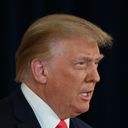
President Trump on Saturday signed four executive orders to provide relief from economic damage sustained during the coronavirus pandemic after talks between the White House and Democratic leadership collapsed Friday afternoon.
Why it matters: Because the Constitution gives Congress the power to appropriate federal spending, Trump has limited authority to act unilaterally — and risks a legal challenge if congressional Democrats believe he has overstepped.
The president said the orders:
- Defer payroll taxes for Americans earning less than $100,000 a year.
- Implement a moratorium on evictions and give financial assistance to renters.
- Add $400 per week in extra unemployment benefits through the end of 2020, and requires states to cover 25% of the additional benefits.
- Postpone student loan interest and payments through the end of 2020.t
What he’s saying: “Through these four actions, my administration will provide immediate and vital relief to Americans struggling in this difficult time,” Trump said at the Saturday afternoon press conference.
- “Maybe they’ll being legal actions, maybe they won’t” Trump said of Democrats in Congress. “They won’t win.” He added that the cases would go “very rapidly” through courts if litigated.
Of note: The president also floated eliminating the payroll tax for Americans earning less than $100,000 a year if he is reelected in November.
- Trump said his administration is considering cuts to income taxes for “middle-income people” as well as capital gains taxes to encourage job growth.
Context: Talks between administration officials and Democratic leaders ended on Friday evening with no agreement and no additional talks scheduled.
- Republicans proposed a $1 trillion plan, while Democrats asked for $3.4 trillion before lowering their request to $2 trillion.
The big picture: It’s also unknown whether these orders are an adequate response to the current needs of the country.
- 29 million adults reported that their household didn’t get enough to eat for the week ending July 7, while states currently face estimated budgets shortfalls of $555 billion through 2022, according to the Center on Budget and Policy Priorities.
- In order to pay for the the deficits, states may have to layoff employees and cut education, health care and services if they do not receive additional federal aid.
- It’s also unclear how suspending payroll taxes will help the millions of unemployed Americans who are not receiving paychecks.
Flashback: This is not the first time Trump has tried to bypass Congress on spending.
- He declared a national emergency in 2019 to shift billions of dollars from the Pentagon budget to help pay for his proposed wall along the U.S.-Mexico border.
Source: https://www.axios.com/trump-executive-order-coronavirus-aid-c0f59817-b95c-440f-86d0-db1e46f4ab64.html
Droolin’ Dog sniffed out this story and shared it with you.
The Article Was Written/Published By: Jacob Knutson
! #Headlines, #Axios, #CoronaVirus, #Economy, #Money, #Newsfeed, #Trump, #Coronavirus, #Health, #News, #Politics, #WorldNews

No comments:
Post a Comment